
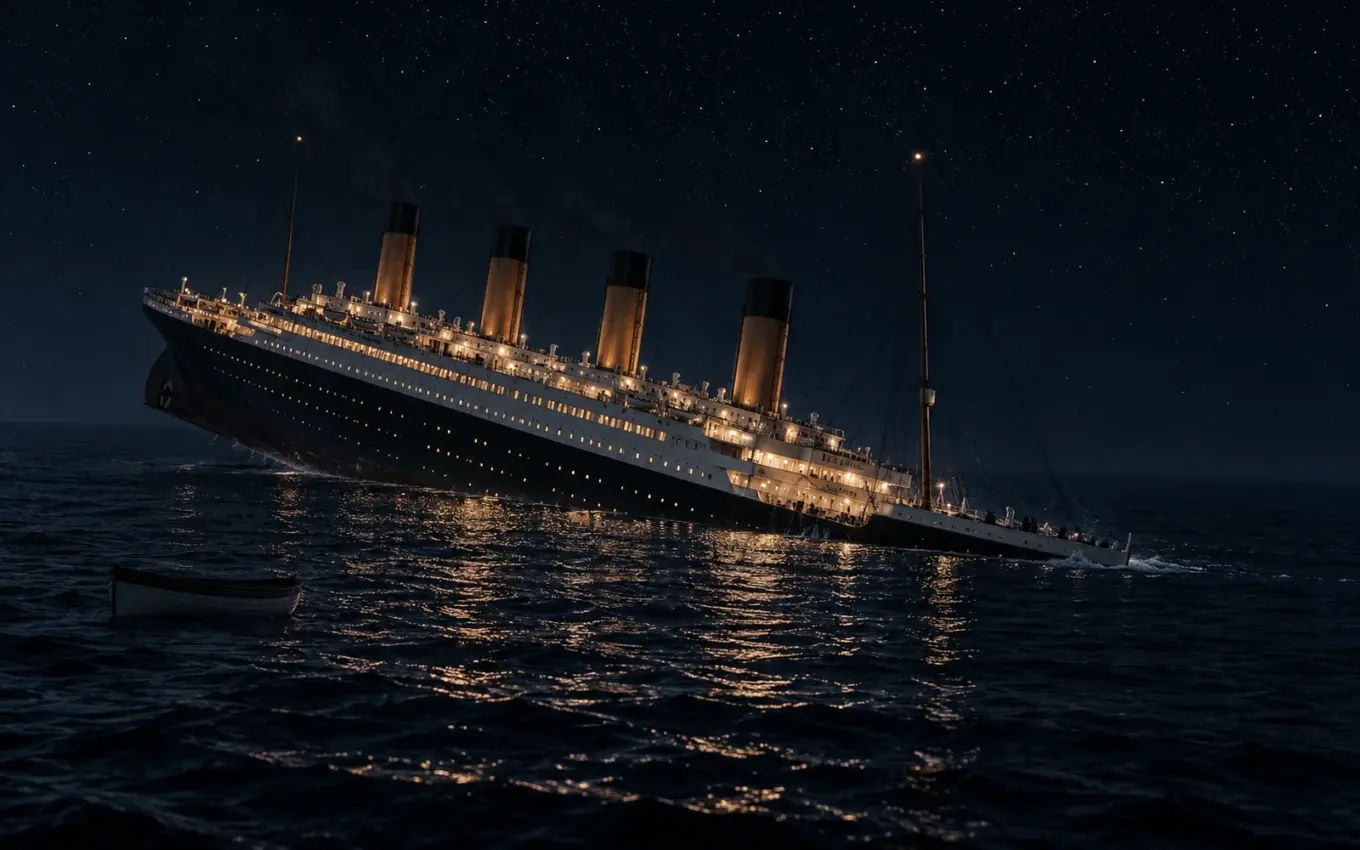
The Titanic sinking began with a collision late on 14 April 1912 and ended in the early hours of 15 April, when the liner disappeared beneath the North Atlantic. More than 1,500 passengers and crew died. A ship celebrated for its scale and luxury became the setting for one of the most studied maritime disasters in history.
Its power has never depended solely on the iceberg. The deeper story concerns the distance between technical achievement and actual protection. Titanic could carry a small society across an ocean, but when that society needed to abandon ship, the available lifeboats could not accommodate everyone aboard.
Before the Titanic sinking
Titanic sailed from Southampton on its maiden voyage on 10 April 1912, bound for New York. Built in Belfast for the White Star Line, it represented an era in which passenger liners were both transport systems and public demonstrations of industrial ambition.
NOAA’s historical overview describes the ship’s international ownership, construction and later significance. Those connections help explain why the loss resonated so widely. The vessel belonged to a network of shipyards, investors, ports and travellers that crossed national boundaries before the disaster itself became international news.
The people aboard did not share one experience of that network. Some travelled in expensive accommodation. Others were making a journey that might transform their economic prospects or reunite a family. Crew members were working. Their different reasons for being at sea would become part of the investigation into how the evacuation unfolded.
The collision changed the meaning of every decision
After Titanic struck an iceberg, damage below the waterline allowed flooding that the ship could not survive. The crisis developed over hours rather than in one instant. That interval created opportunities for action, but it also required people to recognise that a vast, apparently secure vessel was going to be lost.
The US Senate’s historical account of its investigation identifies the issues that investigators examined: ice warnings, speed, communications, evacuation and the treatment of passengers. These were practical questions about decisions made before and after the collision, not merely speculation about the iceberg itself.
The passage of time during the emergency should not be confused with an equal opportunity to escape. Information travelled unevenly through a large ship, people occupied different spaces, and the availability of a place in a boat depended on more than understanding that the vessel was in danger. A catastrophe can unfold slowly while still leaving many of those inside it with very little control.
Enough boats to comply, too few to save everyone
Titanic carried 20 lifeboats with a combined rated capacity of 1,178 people, substantially fewer than the number aboard. The British survey record preserved by the National Archives provides a direct route into the contemporary paperwork behind that provision.
The figures expose the difference between meeting an existing rule and meeting the demands of a real emergency. A ship could satisfy requirements framed around older assumptions while carrying a population those requirements did not adequately protect. Legal compliance and practical survival capacity were not the same thing.
The evacuation added a second layer of difficulty. Boat capacity on paper is not identical to people actually carried away from a sinking ship. Launching arrangements, orders, communication and the willingness or ability of passengers to board all mattered. Once a boat departed, an unused place was no longer a theoretical omission in a design calculation; it was a lost opportunity that could not easily be recovered.
Survivors became witnesses almost immediately
Roughly 700 people survived, rescued by the Carpathia. Their arrival did not lead directly into privacy. American investigators began gathering testimony soon afterward, seeking explanations while the experience was still immediate and while the wider public demanded to know how so many people had died.
The Senate’s collection of investigation records describes hearings involving 82 witnesses. The committee’s published report preserves the resulting conclusions and recommendations. Together, they allow readers to examine contemporary scrutiny rather than rely entirely on later dramatisation.
Testimony is indispensable, but no witness saw the whole disaster. A survivor’s location, role and moment of departure shaped what they could know. The investigation had to assemble accounts from different parts of a ship that no longer existed above the surface. Contradictions were therefore part of the work of reconstruction, not automatic proof that the entire record was unreliable.
The rules changed after the people were lost
The sinking prompted international pressure for stronger maritime safeguards. The first International Convention for the Safety of Life at Sea, known as SOLAS, was adopted in 1914. Its history belongs to the effort to convert public outrage into requirements for ships, equipment and emergency practice.
That reform is central to Titanic’s legacy, but it should not turn the victims into an acceptable price paid for progress. Their deaths exposed weaknesses that had already existed. Improved rules could protect later travellers while leaving the original families with the same irreversible loss.
The North Atlantic did not need to defeat every achievement aboard Titanic. It needed only to expose the gap between what the ship could promise in ordinary service and what it could provide in extremis. More than a century later, that gap remains the story’s most disturbing feature: the lights, the scale and the confidence could continue for a time after the means of saving everyone had already run out.