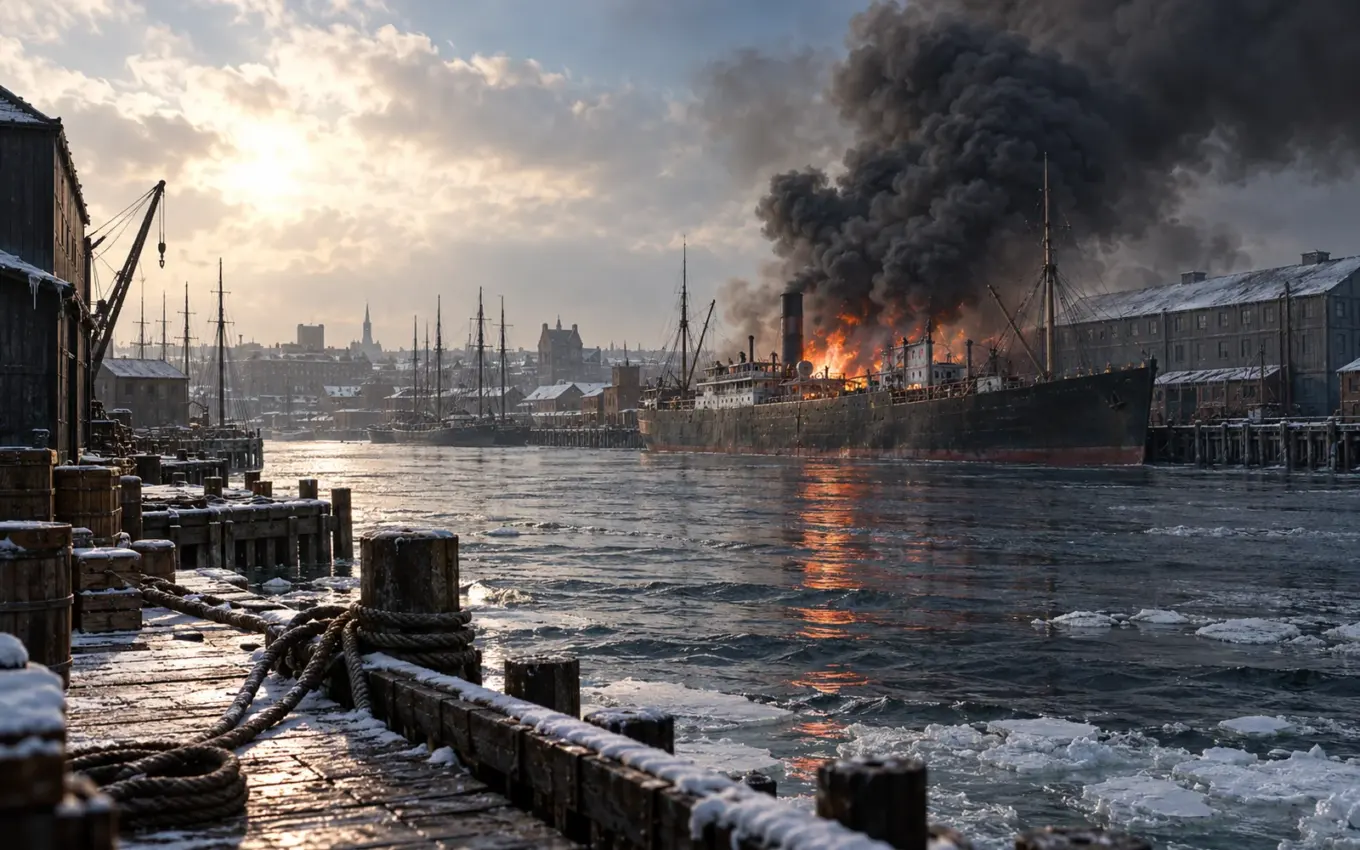
The Halifax Explosion began as a collision in a busy wartime harbour on 6 December 1917. One of the ships, the Mont-Blanc, carried a cargo of high explosives. Fire followed the impact. At about 9:05 that morning, the vessel exploded, devastating nearby communities and killing approximately 2,000 people.
For many residents, the burning ship was something to watch before it became something to fear. The interval between collision and explosion brought spectators toward windows and the waterfront. A distant war had filled Halifax with ships and military traffic; now its destructive materials were about to tear through homes, schools and workplaces beside the harbour.
Before the Halifax Explosion
Halifax was a major Atlantic port supporting the Allied war effort. Ships, railways, factories and residential neighbourhoods existed in close proximity. The harbour was both an international strategic asset and an ordinary place where people earned wages, raised children and began a winter morning.
The Maritime Museum of the Atlantic’s account identifies the vessels’ journeys. Mont-Blanc was arriving with war material for France. The Norwegian Imo was leaving for New York to load relief supplies for occupied Belgium. It was not already carrying that New York cargo when the collision occurred.
The ships met in the Narrows, a constrained section of the harbour. A navigation incident that might otherwise have remained a maritime emergency now involved material capable of destroying a substantial part of the city around it. The scale of the eventual disaster was contained in a cargo most spectators could not see.
A fire drew people toward the danger
After the collision, fire spread aboard Mont-Blanc. Its crew abandoned ship, aware of the explosive cargo. The vessel drifted toward Pier 6 while people on shore watched. They were observing a visible emergency without necessarily knowing the much larger danger hidden inside it.
Parks Canada’s historical designation records the explosion, the resulting wave and the fires that followed. Richmond, close to the waterfront, suffered immense destruction. Buildings collapsed, and people were trapped or injured across a wide area.
The transition was almost instantaneous. Moments earlier, an observer could regard the ship as an object in the harbour. After the blast, the boundary between ship and city no longer offered protection. Windows, walls and ordinary household objects became part of the destructive environment. The catastrophe reached people who had never stepped aboard either vessel.
The warning that outlived its sender
Railway dispatcher Vincent Coleman was working close to the harbour. On learning that the burning ship carried explosives, he sent a warning over the telegraph system before the blast killed him. His action became one of the best-known individual stories associated with the disaster.
The museum’s detailed account of Coleman preserves his story while examining differing evidence about the incoming passenger train. The distinction is valuable: the documented warning and his death do not require every later embellishment about exactly how many people he saved to remain meaningful.
Coleman’s telegraph key and personal effects give the event a scale that casualty totals cannot provide. They belonged to a person who had left home for work that morning. His decision occurred inside the short interval in which danger was known locally but had not yet reached everyone who needed to hear about it.
Communities were lost, not just buildings
The disaster affected a diverse port city. Richmond suffered heavily, and the Mi’kmaw community of Turtle Grove was devastated. The museum records that Mi’kmaw elder Jerry Lonecloud lost two children, Hannah and Rosie. Their names make clear that the harbour’s Indigenous history belongs within the central account of the explosion.
Thousands were injured, and many people lost their homes. Rescue work took place in a damaged city whose communications and transport had also been disrupted. Aid came from nearby communities and farther away, while local residents and personnel from ships in the harbour began helping immediately.
The Nova Scotia Archives’ Halifax Explosion collection preserves photographs, documents and records of the dead. Those materials show that a citywide disaster is also a collection of smaller histories: a family searching for someone, an injured worker reaching medical care, a street whose buildings no longer provide shelter.
A catastrophe followed by the work of a lifetime
Halifax had to rebuild while caring for survivors and identifying those who had died. The archives’ broader historical introduction places that recovery within the city’s development. Rebuilding could replace structures and reconnect services, but it could not restore the exact communities that had existed before the morning of 6 December.
The explosion also revealed the reach of wartime industry far from a battlefield. The cargo was intended for a war across the ocean. Its presence in a civilian port placed a different population within the consequences of that conflict. A harbour designed to connect a city to the world had also brought the world’s destructive capacity to its doorstep.
What endures is the terrifying interval before the blast: a ship burning within view, people watching and only a limited number of people understanding what the fire might release. Halifax shows how information itself can be a form of protection. By the time the danger became unmistakable to everyone, the chance to move away from it had already gone.