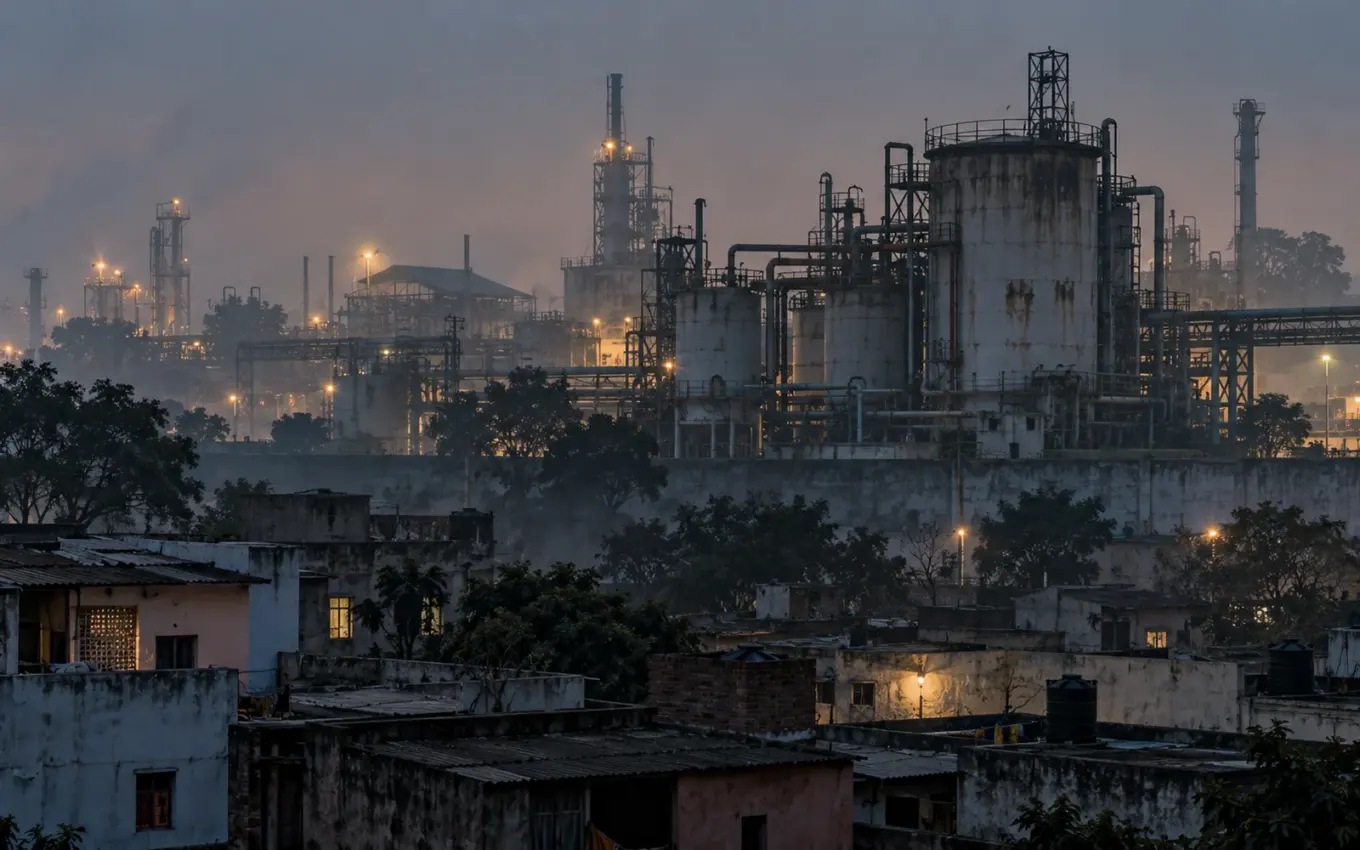
The Bhopal gas disaster reached people in their homes during the night of 2–3 December 1984. A toxic release from a pesticide factory spread into neighbouring communities in the Indian city of Bhopal. Residents who had gone to bed near an industrial plant found themselves inside a catastrophe they had received little preparation to recognise.
Thousands died, and the exposed population numbered in the hundreds of thousands. The immediate emergency was followed by years of illness, research, litigation and demands for accountability. Bhopal became a warning about the distance between possessing dangerous technology and maintaining the systems needed to keep the public safe from it.
Inside the Bhopal gas disaster
The plant was operated by Union Carbide India Limited, or UCIL, associated with the American parent company Union Carbide Corporation. Methyl isocyanate, known as MIC, was stored at the site for pesticide production. A runaway reaction in a storage tank created the conditions for a major toxic release.
The Indian Council of Medical Research’s technical report identifies the reaction and examines shortcomings in storage, refrigeration, monitoring and protective equipment. These were not abstract engineering details. Their purpose was to prevent a hazardous substance inside the factory from becoming a threat outside it.
The release occurred at night, when the surrounding population was particularly vulnerable to delayed warning and confusion. Unlike an obvious fire, a spreading toxic cloud did not give every resident a clear visual explanation of what was happening. Pain, breathlessness and panic arrived before many people could obtain reliable information about the substance involved.
Protection that failed at several levels
Britain’s Health and Safety Executive case study describes rising pressure, equipment that was unavailable or ineffective, and weaknesses in the emergency response. It records water entering the tank as the trigger for an exothermic reaction, while noting uncertainty about the precise route of entry.
The difference between a trigger and the broader causes is important. Identifying how a reaction began does not explain why layers of protection failed to prevent a large release or shield nearby residents. Industrial safety depends on barriers working together: appropriate storage conditions, effective maintenance, detection, containment, warning and coordinated emergency plans.
In Bhopal, the consequences crossed the factory boundary. Residents had not chosen to accept a workplace exposure, and children had no role in deciding how the plant operated. The disaster therefore exposed a fundamental issue of public responsibility: communities can bear the greatest risk from industrial decisions over which they exercise the least control.
Hospitals faced a catastrophe without clear information
The medical emergency developed rapidly. The HSE account notes that emergency services were overwhelmed and that hospitals initially lacked essential information about the gas and its effects. Medical staff had to treat large numbers of people while trying to understand an unfamiliar exposure.
The ICMR report on clinical studies documents the scale of illness and the research that followed. Severe effects on the respiratory system and eyes made the disaster immediately visible in clinics and hospitals. Researchers then faced the more difficult work of following health outcomes beyond the first emergency.
That transition matters. An industrial disaster does not end when the plume disperses. A survivor may need repeated care while also dealing with reduced income, displacement or the loss of a family member. The emergency produces a medical record; the aftermath produces a lifetime in which that record may be needed again and again.
Why the death toll needs a time frame
Bhopal is often described with one dramatic number, but published totals vary according to the period counted, the population examined and the method used to attribute later deaths. Early estimates of roughly 2,000 deaths concern the first days. They should never be presented as the final toll of the entire disaster.
The ICMR’s longer research programme demonstrates why sustained observation was necessary. Immediate fatalities, subsequent mortality and chronic illness describe related but distinct consequences. A total that combines them without explaining its basis can create an appearance of precision that the evidence does not support.
The uncertainty concerns measurement, not whether immense harm occurred. Thousands died, and many more suffered. For a family living with that harm, the question of whether an illness appeared in an official table could also affect recognition, compensation and the public understanding of what had been taken from them.
The city that remained after the cloud
Bhopal’s international significance rests partly on how ordinary the underlying arrangements appeared. A factory stood near residential neighbourhoods. Workers maintained equipment. Administrators assessed costs and responsibilities. Residents expected to be able to sleep safely at home. The disaster revealed how catastrophic the failure of those connected assumptions could become.
Its history also demands care with corporate names and legal responsibilities. UCIL operated the Indian plant; Union Carbide Corporation was the American parent. Later ownership changes and court proceedings are separate parts of a complicated record. Compressing every actor into one interchangeable name can obscure the very accountability a serious account should clarify.
The enduring terror of Bhopal is the absence of a safe boundary. The danger did not remain inside a reactor vessel or a factory fence. It moved through streets and into rooms where people were asleep, turning proximity to an industry into exposure to its failure. The survivors’ long struggle makes the larger lesson impossible to confine to one night: safety must be maintained before an emergency, because recognition after it cannot give people back the air they breathed.