The Lake Nyos disaster left villages in northwestern Cameroon devastated without a conventional explosion, a sweeping fire or an advancing army. On 21 August 1986, a large release of carbon dioxide from the lake spread into surrounding low ground. At least 1,700 people died, along with large numbers of animals.
The catastrophe was frightening partly because the landscape did not offer an obvious explanation. A lake that had been part of everyday life had become the source of an invisible, suffocating hazard. Scientists arriving afterward had to reconstruct how deep water could store a lethal threat and then release it across inhabited valleys.
What caused the Lake Nyos disaster?
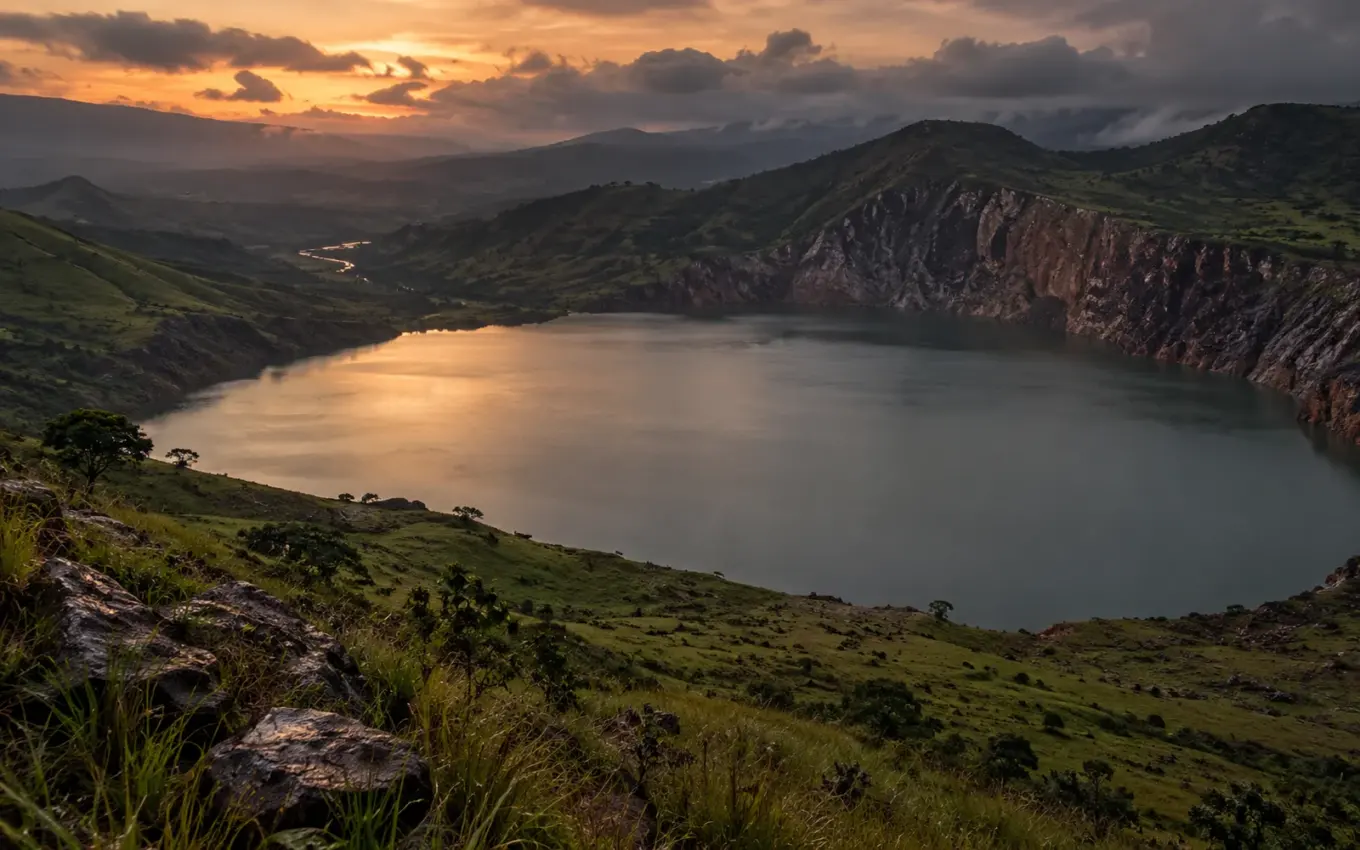
Lake Nyos occupies a volcanic crater. Gas originating beneath the lake had accumulated in its deep water. At depth, pressure allows substantial quantities of carbon dioxide to remain dissolved. Under unstable conditions, a rapid release can bring gas out of the water and into the air above it.
The US Geological Survey’s investigation report examines the 1986 event and the evidence collected afterward. The disaster is commonly described as a limnic eruption: a sudden release of dissolved gas from a lake. That explanation differs from an eruption in which molten rock or a blast of hot volcanic material directly overruns a village.
The distinction helps explain the unusual aftermath. Buildings could remain standing while the people and animals around them had died. The destructive agent was not force applied to a structure. It was a dangerous change in the air occupying the spaces where living things needed to breathe.
The gas followed the shape of the land
Carbon dioxide is denser than ordinary air. In a large, concentrated release, it can collect and move through low-lying terrain, displacing breathable air and creating a lethal environment. Around Nyos, the surrounding valleys helped determine which communities were exposed and how the danger travelled.
The Smithsonian Global Volcanism Program’s contemporary report records field observations, survivor information and the heavy loss of life. It also describes visible changes at the lake, including the altered colour of its water, as investigators assessed what had happened.
The pattern was difficult to comprehend without the underlying science. A natural feature associated with water and fertility had produced an atmospheric emergency. Survivors did not need a theory of dissolved gas to experience its consequences; researchers needed one to explain why the deaths had occurred and whether they could happen again.
A landscape of losses
The death toll is usually expressed as roughly 1,700 to 1,800, with differences among historical sources. Using “at least 1,700” reflects the scale without pretending every published assessment used the same counting method. The loss of livestock added to the destruction of households and livelihoods.
NASA’s Earth Observatory account connects the event to the lake’s physical setting and the later efforts to make it safer. The landscape is central to the history, but a satellite view cannot show what it meant to discover that a neighbouring household had been lost or that a familiar route now led through a disaster zone.
For people who survived, the question of returning carried a cruel uncertainty. The lake had not disappeared. The land still held practical and personal value. Yet the feature at the centre of the community’s geography had demonstrated a capacity for sudden, catastrophic harm. Survival therefore did not restore the previous relationship between people and place.
The trigger and the underlying danger
Scientists have investigated possible triggers for the sudden release, including disturbance of the water column. The precise initiating sequence should not be presented with more confidence than the evidence allows. Understanding the stored gas and the release mechanism is not identical to proving every event that occurred immediately before the eruption.
A later USGS study of changes within the lake followed its water chemistry and structure over several years. That work shows why an investigation could not end with a single explanation of the original catastrophe. Researchers also needed to know how the lake was changing afterward.
This is a distinctive feature of Nyos. The source of the danger was a continuing natural system, not a machine that could simply be switched off or dismantled. Scientific understanding had to support a way of living with the lake while reducing the possibility of another uncontrolled release.
The effort to give the lake a safer outlet
In 2001, a degassing installation began removing gas from the deep water in a controlled way. Two additional pipes followed in 2011. The aim was to reduce the accumulated reservoir of dissolved carbon dioxide rather than wait for another sudden discharge.
The engineering response gave the story a measure of practical hope. A hazard that initially seemed extraordinary and almost unknowable could be studied, monitored and reduced. That achievement should not be confused with a promise that a complex landscape can be declared permanently free from every risk. It demonstrates the value of sustained observation and intervention.
Lake Nyos remains one of the most unsettling disasters of the twentieth century because it challenged the senses. There was no need for flames to make a place deadly, and no requirement that a catastrophe destroy the buildings it passed. The decisive change occurred in something people could not afford to stop using for even a moment: the air around them.