
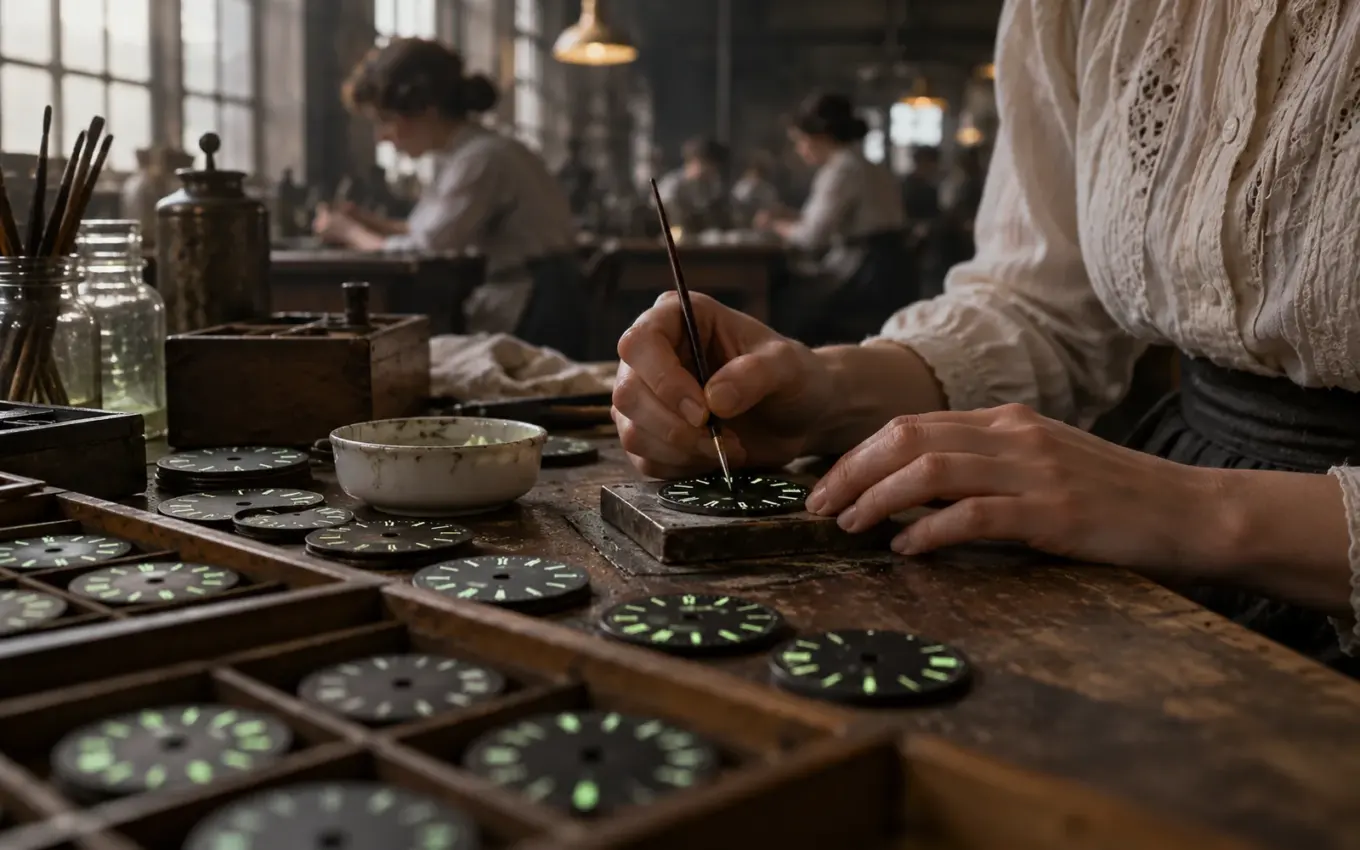
The Radium Girls painted tiny numbers that made watches and instruments readable in the dark. Their work demanded precision, and the luminous paint looked like a product of scientific progress. The danger entered through a small, repeated action: bringing a paintbrush to the lips to form a fine point.
The workers swallowed radioactive material while doing their jobs. Some later developed devastating illnesses, including serious damage to the jaw and bones. Their struggle to establish what had happened became a landmark in the history of occupational disease: the product continued to glow while the people who made it fought to have their suffering believed.
The Radium Girls and the promise of a new element
Radium entered public life surrounded by extraordinary optimism. Its medical potential, scientific novelty and luminous applications encouraged the idea that it belonged to a modern, beneficial future. That reputation made the reality of harmful workplace exposure especially difficult for the public to reconcile with the element’s celebrated image.
The Smithsonian’s history of radium and American public enthusiasm describes the excitement surrounding Marie Curie and a 1921 campaign to provide her with radium for research. Curie’s scientific work and the industrial treatment of dial painters were different activities, but both occupied a culture fascinated by the new material.
In the factories, the attraction was practical. Luminous dials allowed numbers to be read without an external light. The workers’ skill made that convenience possible. Their task looked delicate and controlled: a brush, a small surface and a line of paint. The scale of the object gave no reliable indication of the scale of the hazard.
A routine action created an internal exposure
Workers used their lips to shape brush tips, a practice that transferred radium-bearing material into their bodies. Once ingested, radium can behave chemically like calcium and become incorporated into bone. The resulting exposure does not end simply because the worker leaves the factory at the end of a shift.
The US government’s toxicological profile for radium explains the element’s health effects and the importance of internal exposure. The dial-painting cases made the consequences painfully concrete. A substance used to illuminate an instrument could produce disease within the person applying it.
That delay between exposure and recognised illness created an additional obstacle. A sudden injury on a factory floor is usually connected to a visible event. Occupational disease may appear gradually, after repeated contact, and can require specialised investigation to establish its cause. The passage of time can make proof harder precisely when the worker’s need for support grows greater.
Evidence came from the workers themselves
The story involves several workplaces and companies, not a single factory. The United States Radium Corporation in New Jersey and Radium Dial in Ottawa, Illinois, belong to related but distinct histories. Combining every woman and lawsuit into one proceeding erases important differences in employer, location and chronology.
A National Institute of Standards and Technology history of the dial painters traces the scientific examinations used to detect internal radioactivity. Its record includes tests involving Grace Fryer and four other women in the late 1920s. Measurements helped turn symptoms that could be dismissed individually into evidence of a shared industrial exposure.
The process reveals an uncomfortable imbalance. Employers and experts could debate causation while the workers lived with the consequences. To make a claim, an ill person needed more than an account of pain. She needed a connection between work and disease that could survive medical disagreement, institutional resistance and the demands of a legal case.
The fight in Ottawa
In Illinois, Catherine Wolfe Donohue became a central figure in the struggle against Radium Dial. Her case reached a successful workers’ compensation decision in 1938. The achievement belonged to women who had already paid a terrible personal price for the work that made their claim necessary.
The Environmental Protection Agency’s history of the Ottawa radium sites places Donohue’s case within the city’s industrial legacy. It also records the later environmental work required where radium processing had left contamination behind. The story extended beyond an employer’s payroll and beyond the years when the original dial painters were at work.
A legal victory could establish responsibility and provide support. It could not remove the exposure that had already occurred inside a worker’s body. That difference gives the litigation its force. The women were fighting for recognition while time, illness and the ordinary expense of living continued to work against them.
A glow that lasted longer than the job
The EPA’s assessment of radium-site cleanups documents another form of persistence: radioactive contamination could remain an environmental problem long after the industrial activity that produced it. The history of the workers and the history of the sites therefore intersect without being identical.
The Radium Girls helped change public understanding of occupational harm. Their experience showed why a manufacturer’s confidence, a product’s popularity or the absence of an immediate injury could not serve as proof of safety. It also demonstrated the importance of records capable of connecting an individual illness to a pattern of exposure at work.
What makes the story so haunting is the intimacy of the betrayal. The danger did not arrive through a dramatic accident. It was built into a repeated gesture performed in the expectation of earning a living. Each precise brushstroke contributed to a useful object, while an invisible burden accumulated in the worker whose skill made that object possible.