The Great Smog of London settled over the city on 5 December 1952. Fog was familiar to Londoners, and coal smoke was part of the winter landscape. This time, a combination of cold weather, trapped pollution and almost motionless air created something far more dangerous than a difficult journey home.
For five days, the city struggled inside a filthy atmosphere that restricted movement and damaged lungs. Thousands died. The full scale of the disaster was not visible at any single street corner: it emerged through hospitals, death registrations and later analysis. The air had become a mass killer without leaving the kind of wreckage people expected from a catastrophe.
How the Great Smog of London formed
A cold spell increased the burning of coal in homes. Industrial sources added their own emissions. Normally, the atmosphere could disperse some of that pollution. In December 1952, a persistent area of high pressure created a temperature inversion that held colder air close to the ground beneath warmer air above it.
The Met Office’s explanation of the Great Smog describes the resulting accumulation of smoke, gases and fog. Weak winds offered little relief. The pollution remained concentrated in the layer of air through which Londoners walked, worked and breathed.
Weather supplied the conditions that trapped the emissions; the emissions supplied the hazard. Calling the event a freak fog alone misses that relationship. The city was not simply unlucky enough to receive an unusual cloud. Its heating and industrial systems had produced material that became especially dangerous when the atmosphere stopped carrying it away.
A familiar city became difficult to navigate
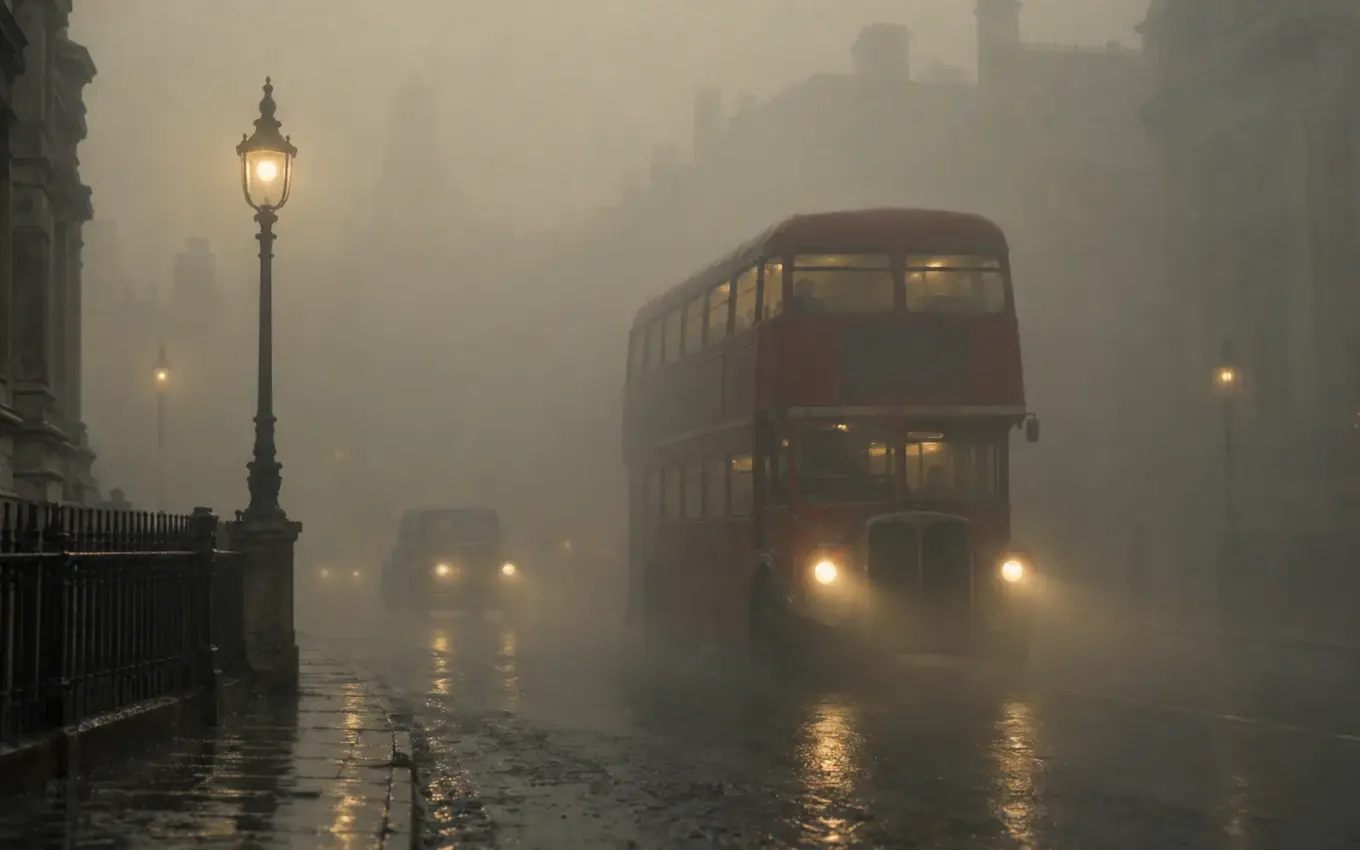
As the smog thickened, visibility in some places fell to only a few metres. Pedestrians struggled to find their way even in neighbourhoods they knew well. Transport was disrupted, and the normal relationship between a city and its visible landmarks began to break down.
That loss of visibility was the most obvious part of the emergency. It was also a distraction from the more serious danger. Someone could understand that the street was difficult to cross without recognising how harmful the air itself had become. The obstacle was not confined to an intersection or a stretch of road that could simply be avoided.
London’s earlier smoke episodes had made dirty fog feel like an established feature of urban life. Familiarity did not make it harmless. In 1952, the difference between an accepted nuisance and a lethal exposure became clear only after the health consequences had already begun to accumulate.
The toll appeared in the death records
Early assessments associated the episode with roughly 4,000 excess deaths. Later work suggested a much higher toll, with estimates reaching approximately 12,000 when a longer period and additional effects were considered. These figures are not two rival headcounts taken at the same moment; they reflect different ways of measuring mortality after the event.
The UK Parliament’s briefing on air quality places the 1952 disaster within the history of pollution and public health. The Royal College of Physicians and Royal College of Paediatrics and Child Health report discusses the larger estimate in that continuing context.
The statistical nature of the toll can make the event seem remote. There was no single list of people trapped inside one building, and no common moment at which every victim died. Yet excess mortality represents individual deaths that occurred above what would otherwise have been expected. The method is abstract; the losses it seeks to identify are not.
When staying warm contributed to the danger
The smog exposed a cruel dependency. Burning fuel kept homes warm during cold weather, while the combined emissions made the surrounding air hazardous. People acting to meet an immediate need contributed to a collective danger they could not solve household by household.
Parliament’s historical account of Britain’s energy use connects coal consumption with the pressure for cleaner air. The problem required changes to infrastructure, regulation and available fuels, not merely an instruction for individual residents to tolerate colder rooms.
That is one reason the disaster mattered beyond London. It demonstrated how a widely shared practice could impose a serious public cost under particular environmental conditions. Smoke rising from many separate chimneys became one exposure affecting a whole population. No household owned the atmosphere into which it was releasing its waste.
Clearer skies did not mean an instant solution
The smog dispersed on 9 December when the weather changed. Its departure restored visibility more quickly than it restored health or public confidence. The subsequent Clean Air Act of 1956 became a major part of the response, with further legislation and changes in fuel use contributing to improvement over time.
The reform story should not be told as an overnight transformation. Households and industries needed alternatives, enforcement took work, and later pollution episodes still caused deaths. A law could establish a direction without immediately removing all the sources of harm built into the city’s daily life.
The Great Smog’s most disturbing lesson lies in how little the danger resembled an invasion. It came from familiar fires, familiar chimneys and the familiar effort to keep winter outside. London continued to look like London beneath the haze. Only later did the records reveal how many people had been lost while the city was waiting for the fog to lift.