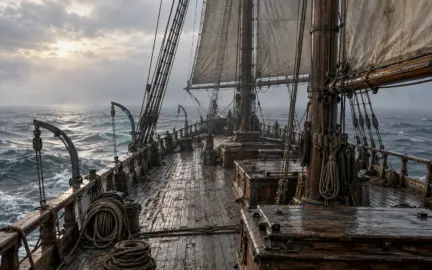
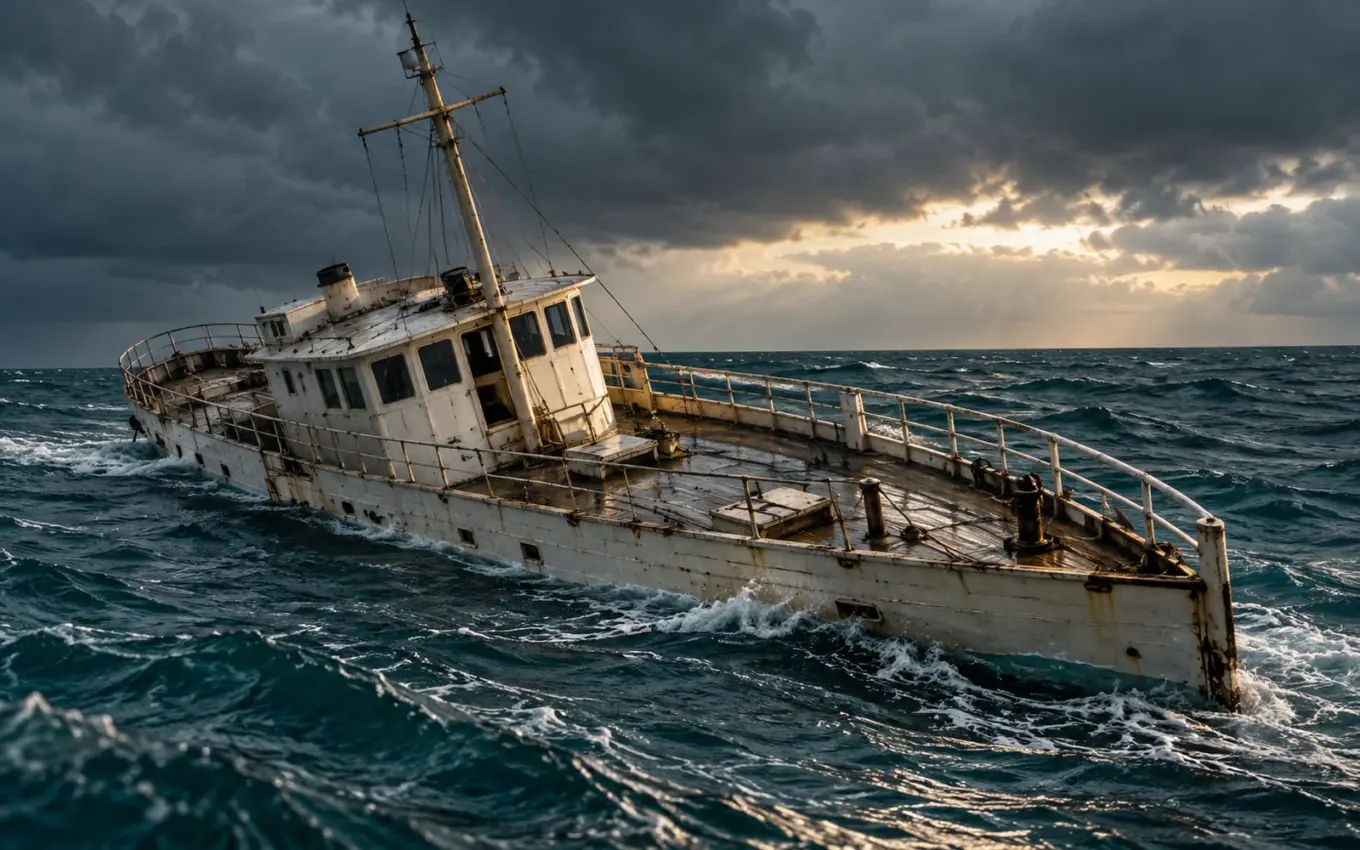
The Joyita mystery began with an overdue voyage and became something stranger when the vessel came back without the people. In November 1955, she was found drifting north of Fiji, damaged and badly listing, but still afloat.
Twenty-five passengers and crew had left Samoa aboard her more than a month earlier. None was present to explain why the vessel had been abandoned. [1]
The First Days of the Joyita Mystery
Joyita departed Apia on October 3, bound for Tokelau. It was a voyage within the connected working world of the South Pacific: passengers, cargo, islands and schedules rather than an expedition intended to enter the unknown.
When she failed to arrive, a search began. No message or sighting supplied a reliable location for the missing people. Weeks passed before the vessel herself was found on November 10. [1]
An overdue ship creates two overlapping emergencies. People aboard may need help immediately, while people ashore must first establish where that help is needed. The longer the vessel remains unseen, the larger the area in which a search must make its decisions.
Discovery normally narrows that area. It can offer survivors, a wreck site or material showing what happened.
Joyita provided a vessel without providing an ending.
A Damaged Vessel That Would Not Sink
The condition of the ship became central to the inquiry. She was in poor repair. Later summaries of the evidence describe flooding associated with a damaged pipe, problems with pumping and a radio installation whose faults limited effective communication. Yet her construction and buoyancy helped keep her afloat. [4]
Those facts are unsettling together. A boat can look as though it is sinking while retaining enough buoyancy to survive for a long time. People aboard may not know how much water it will take, how rapidly the situation will worsen or whether a distress call has reached anyone.
That does not prove what the people on Joyita believed. It shows why the vessel’s survival cannot, on its own, establish that leaving her had seemed irrational to them.
The ship carried information in her damaged condition, but only information about the ship. Water inside a hull does not record the conversation in which people assess it. A faulty radio does not preserve the moment someone realises help may not have heard.
The smaller craft and rafts were missing. The people might have attempted to use them. What they encountered after leaving, if that is what happened, was not documented by a returning survivor. [4]
An Inquiry Without the People
In February 1956, a formal inquiry sat in Apia. Contemporary reporting in Pacific Islands Monthly describes the commission gathering evidence about Joyita’s condition, the voyage and the circumstances of the discovery. Witnesses could discuss technical matters and put forward possible sequences.
They could not supply direct testimony from any of the twenty-five missing people. [1]
The National Library of New Zealand preserves the inquiry’s bibliographic record and a substantial collection of investigative papers assembled by journalist Jack Thornton. That collection includes correspondence, reports, press material and efforts to establish what happened. [2][3]
The existence of those records is important. The Joyita mystery did not persist because nobody examined the vessel or thought to ask practical questions. People investigated. They considered its engineering and sought evidence from those who had known the voyage and its master.
The surviving material could explain aspects of the emergency without reconstructing the fate of everyone inside it.
That is a difficult kind of incompleteness. A mystery with no evidence invites imagination. A mystery with substantial technical evidence can appear to be one final document away from resolution, even when the missing information was carried away by the people themselves.
The Space Beyond the Rail
Stories about abandoned ships often dwell on objects: clothing, equipment, food, a log. Those details are useful only if they help separate what is known from what a later narrator has supplied.
The most consequential object in the Joyita story was the vessel herself. She survived the event that removed her passengers and crew. Her continued flotation made a question visible that a sinking might have concealed: why had the people and their larger shelter become separated?
It may have happened during a frightening mechanical emergency. It may have involved decisions that seemed necessary with the information available. The record does not permit an exact scene of the departure.
Nor does it establish an attack by pirates, a secret interception or a supernatural disappearance. Those explanations are not made stronger by the absence of witnesses who could contradict them.
What remains is a deeply human danger: a group far from land, uncertain whether their vessel will keep them alive, with help unable to find them in time.
Weeks afterward, the sea returned something a searcher could identify. It was not a survivor waving from the rail. It was a listing ship still doing the one thing that might once have mattered most.
Joyita was still afloat.
Sources and record notes
Record type: Researched nonfiction. Filed: October 15, 2026.
Established facts: Joyita departed Apia on 3 October 1955 with 25 people aboard, bound for Tokelau. She was found deserted north of Fiji on 10 November. A 1956 inquiry examined the vessel and its condition without establishing the people’s fate.
Uncertainty: The reason and exact sequence of abandonment are unknown. Contemporary inquiry reporting identifies Apia as the departure port and Tokelau as the intended destination.
- Pacific Islands Monthly, February 1956 — Inquiry Into the Joyita Mystery
- National Library of New Zealand — Jack Thornton’s Joyita investigation records
- National Library of New Zealand — 1956 Joyita inquiry catalog record
- Wikipedia — MV Joyita (secondary account of mechanical findings)
Explore the DarkRecord story archive, or read how DarkRecord labels and sources its stories.