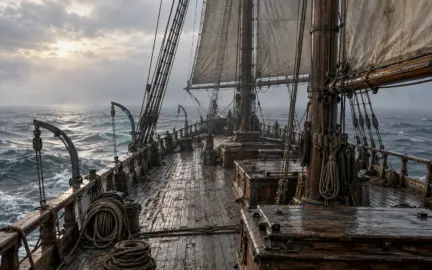
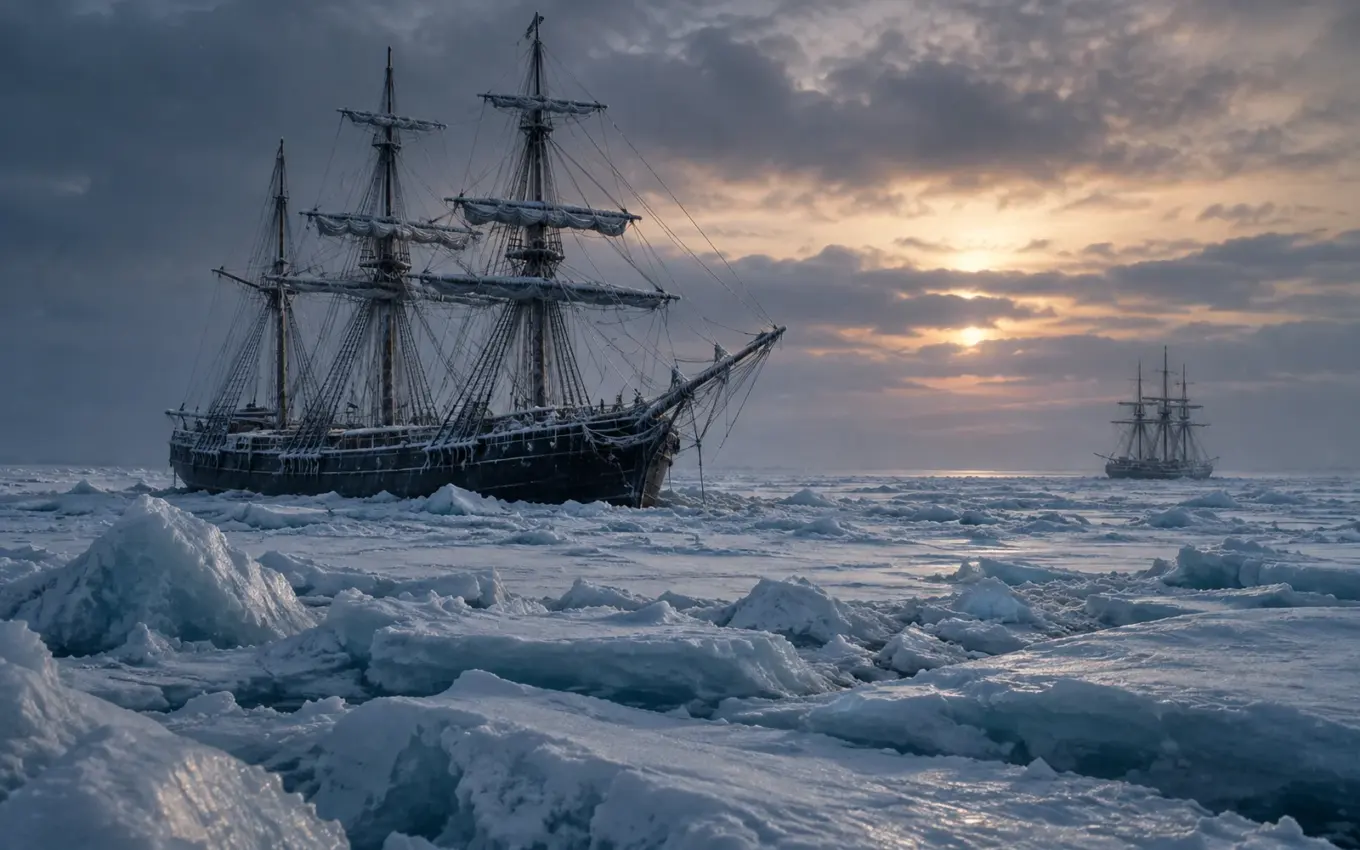
The Franklin expedition carried enough supplies for years. Its ships were fitted for Arctic work, its officers had experience and its purpose was a route through the ice, not a winter in which the ice would refuse to release them.
By April 1848, the surviving men had abandoned HMS Erebus and HMS Terror. Their commander was dead. The ships that had been shelter, transport and the centre of their working world had become places they could no longer afford to wait. [1][2]
The Franklin Expedition Enters the Ice
Sir John Franklin’s expedition left England in May 1845. After five men were sent home during the early voyage, 129 officers and crew continued into the Arctic. The ships had been equipped with contemporary technology and carried substantial provisions.
They wintered at Beechey Island in 1845–1846. In September 1846, Erebus and Terror became trapped in ice near King William Island. According to the surviving written record, they were still there when the crews abandoned them on April 22, 1848. [1]
A ship built to move can serve as shelter when it stops. For a time, that distinction may be reassuring. Supplies can be rationed, work organised and the expected return of navigable water treated as a problem of patience.
But patience consumes provisions. A second winter is not simply the first winter repeated. The people facing it have already used part of what will keep them alive, and the season they waited for has not delivered the movement on which the plan depended.
The danger did not have to arrive as a single spectacular impact. It could accumulate while the men continued to live aboard.
The Message That Changed
The most important written clue was a note left near Victory Point. It preserved an earlier account of the expedition and a later addition explaining that the ships had been deserted. Franklin had died on June 11, 1847. Responsibility had passed to Francis Crozier, with James Fitzjames among the remaining senior officers. [2]
The note is frightening because it records a change in what survival required. A vessel was normally the safest and most organised place available to a naval crew. Leaving both ships meant the remaining men were accepting the dangers of travel over an immense, demanding landscape because staying had ceased to offer a sufficient future.
The exact experiences of every group after that decision are not recoverable from a single document. A note can identify a departure. It cannot accompany every exhausted person who follows the route south.
The Franklin expedition’s final written record therefore gives us a threshold rather than a complete ending: behind the men, the ships; ahead, the land and ice on which they now had to survive.
People Who Saw What Followed
The expedition did not vanish from a world without inhabitants. Inuit witnessed parts of its aftermath and preserved knowledge about the men and ships. That knowledge was essential to the search for an explanation and later to the discoveries of the wrecks.
Parks Canada’s history identifies Inuit as integral to solving the mystery. Accounts carried through Inuit oral traditions helped establish that the men had travelled overland and that the ships’ histories continued beyond the point at which European written records stopped. [2]
The Canadian Museum of History presents the case through objects, historical evidence and the long effort to understand the loss. All 129 men who continued into the Arctic died; none returned to provide a complete narrative. [3]
The evidence includes the terrible effects of starvation and, in some recovered remains, signs associated with survival cannibalism. University of Waterloo researchers have documented such evidence in their work identifying James Fitzjames. [5] Those findings should not become an excuse to replace the men with grotesque characters. They belong to the history of people pushed beyond the limits of an expedition’s planning.
Nor is there one neat cause that can responsibly be made to explain every death. Cold, illness, nutrition, exhaustion and the difficulty of travel formed a changing situation. An explanation that attributes the entire disaster to one convenient substance or mistake promises more certainty than the record allows.
The Ships Beneath the Water
Erebus was located in 2014. Terror was found in 2016. The discoveries transformed two missing ships into archaeological sites that could be investigated. Parks Canada’s account places Inuit knowledge and collaboration within that history. [4]
Objects surviving inside a wreck have a peculiar effect on a story of disappearance. They make the past look close: workspaces, fittings and possessions can remain arranged in ways that suggest ordinary use. But material preservation does not restore the people who used them.
The wrecks answered major questions about where the ships ended up. They did not create a complete account of the final journeys ashore.
That is where the Franklin expedition remains most unsettling. The ships were not lost because their names had been forgotten. They were searched for because a great many people expected their crews to return. For years, absence was something to be investigated rather than accepted.
Now the vessels have locations. Their timbers and contents can be examined. The ice that trapped them is part of a mapped history.
But the final journey still breaks into fragments: a note, testimony, belongings, remains.
The ships waited through the seasons. At some point, the men could wait no longer. They stepped away from the last substantial shelter they knew, and no one who made that departure came home to tell the whole story.
Sources and record notes
Record type: Researched nonfiction. Filed: October 15, 2026.
Established facts: HMS Erebus and HMS Terror sailed on Franklin’s 1845 Arctic expedition. The ships became icebound and were abandoned in 1848. None of the 129 men who continued into the Arctic returned. Their wrecks were located in 2014 and 2016.
Uncertainty: The full sequence of the final journeys remains incomplete. Inuit knowledge is evidence that helped establish the history and locate the wrecks. Lead poisoning alone is not presented as a settled explanation.
- Parks Canada — Franklin’s 1845 expedition
- Parks Canada — Who’s who in the Franklin expedition
- Canadian Museum of History — Mystery of the Franklin Expedition
- Parks Canada — The Wrecks of HMS Erebus and HMS Terror
- University of Waterloo — DNA identification and evidence from the remains of James Fitzjames, 2024
Explore the DarkRecord story archive, or read how DarkRecord labels and sources its stories.