The most unsettling thing about the Mary Celeste mystery is that the ship survived. When sailors from another vessel boarded her in the Atlantic in early December 1872, they found a craft that could still be sailed. They did not find the ten people who had entrusted their lives to her.
The lifeboat was gone. Food and water remained. The ship’s company had disappeared into an ocean that would return the vessel but withhold the reason they had left it. [1]
A Voyage With a Family Aboard
Mary Celeste sailed from New York on November 7, bound for Genoa with a cargo of industrial alcohol. Captain Benjamin Spooner Briggs travelled with seven crew members, his wife Sarah and their two-year-old daughter Sophia. Their son Arthur had stayed behind to attend school.
Briggs was an experienced captain. The surviving account of his career does not suggest a man casually willing to exchange a substantial sailing ship for a small open boat. That distinction is central to the case. Whatever happened, an explanation must account for people leaving a vessel that later remained serviceable. [1]
The voyage crossed a working ocean, not an empty stage. Merchant ships followed routes, carried schedules and depended on equipment that could fail far from repair. Rough weather, uncertain position and water entering a hull were practical dangers. A decision that appears irrational from a dry room on land might look different to a captain without reliable information about his ship.
Yet no explanation can simply be inserted into Briggs’s mind. His last decision is precisely the part that did not survive.
What the Mary Celeste Mystery Left Behind
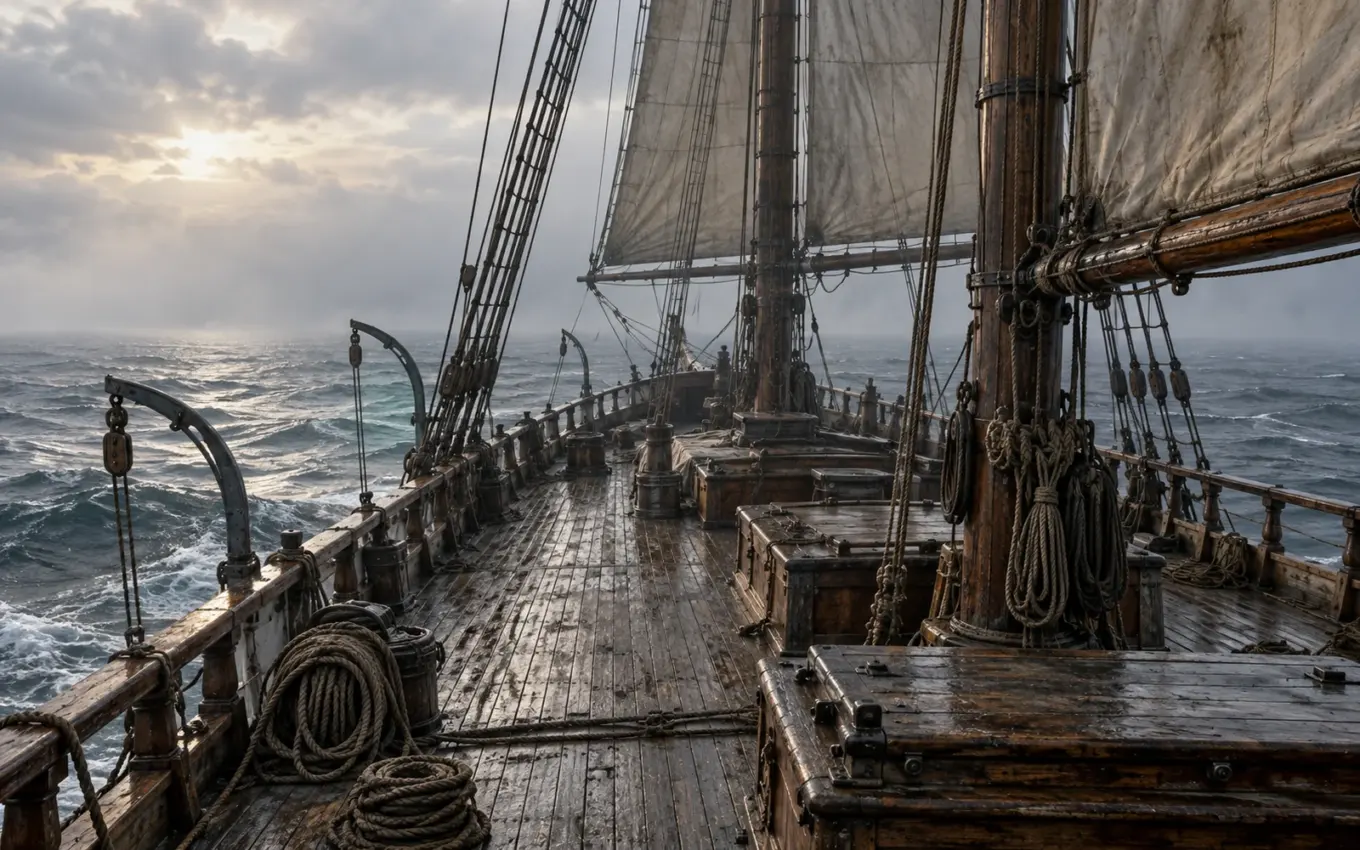
The brigantine Dei Gratia encountered Mary Celeste east of the Azores. The approaching ship’s behaviour prompted concern. A boarding party went across and discovered the absence that made the case famous.
The final surviving log entry was dated November 25. By the time of discovery, days had passed without a recorded explanation for what followed. The smaller boat was missing, while possessions and substantial provisions remained aboard. Water had entered the hold, but the vessel was not beyond salvage. [2]
Those details create a frightening imbalance. The larger ship had carried the water, food, shelter and equipment that people at sea needed. The missing boat represented a much smaller margin between survival and the weather.
If the people aboard left voluntarily, they must have regarded leaving as the safer choice at that moment. If they expected to remain close to the ship, a separation might have transformed a temporary precaution into a catastrophe. Those are possibilities, not a recovered sequence. No witness returned to establish which danger they believed they were escaping.
The boarding party had found the consequence of a decision without finding the decision itself.
What the Inquiry Could Not Supply
The recovered ship was taken to Gibraltar. The salvage proceedings grew into an investigation of whether a crime had occurred. Suspicion fell on several possibilities, but the inquiry did not establish foul play. None of the missing ten returned to resolve the questions. [3]
Later accounts supplied the kind of scene the evidence had withheld. They populated the ship with violence, strange forces and dramatic signs of an interrupted meal. Fiction helped turn an abandoned merchant vessel into a ghost ship, sometimes obscuring how little the original evidence actually supported.
Arthur Conan Doyle’s fictional treatment, published in 1884, was particularly influential. Its existence is a warning about this case: a story can become familiar enough to feel like a historical source while remaining an invention. [2]
The real Mary Celeste mystery does not need that additional scenery. It already contains an absence larger than anything a novelist needs to place on deck.
Ten people had been present. Their disappearance did not take the ship with them.
The Danger They May Have Misread
Modern examinations have considered the alcohol cargo, the ship’s pumps, weather and navigation. A documentary investigation reported by Smithsonian explored whether unreliable pumping and uncertainty about water in the hull could have helped prompt abandonment. Other reconstructions have considered vapour or a feared explosion. None is an eyewitness account of the final event. [1][2]
The distinction between danger and perceived danger is what makes these explanations so uncomfortable. A threat does not have to destroy a ship to make someone leave it. It only has to persuade the people aboard that destruction is coming.
The ship’s subsequent survival cannot tell us what information Briggs possessed. It cannot tell us whether he intended to return within minutes. Above all, it cannot show what happened once the people and the ship were no longer together.
There is no established final image of the lifeboat: no known direction, no confirmed last conversation, no witness to its disappearance. Writing one would make the story easier to picture and less true.
Instead there is the larger vessel, capable of continuing, carrying the belongings of people who did not come back for them.
For more than a century, the question has been why a captain abandoned a ship that remained afloat. The deeper discomfort is that the ship may have been the safest place available, and nobody can now tell us when that became clear to the people who had left it.
Sources and record notes
Record type: Researched nonfiction. Filed: October 15, 2026.
Established facts: Mary Celeste left New York in November 1872 with ten people aboard. She was found deserted in early December with her lifeboat missing, supplies remaining and no proven explanation for the abandonment.
Uncertainty: The order to abandon ship, its reason and the fate of the lifeboat are not known. Competing mechanical and weather explanations remain reconstructions. Discovery dates differ by land and nautical dating conventions.
- Smithsonian Magazine — Abandoned Ship: The Mary Celeste
- Smithsonian Magazine — An Abandoned Merchant Ship Was Discovered Floating in the Atlantic in 1872
- Wikipedia — Mary Celeste (secondary chronology and references)
Explore the DarkRecord story archive, or read how DarkRecord labels and sources its stories.