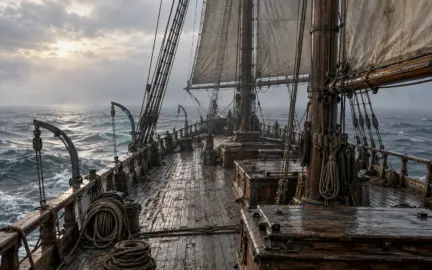
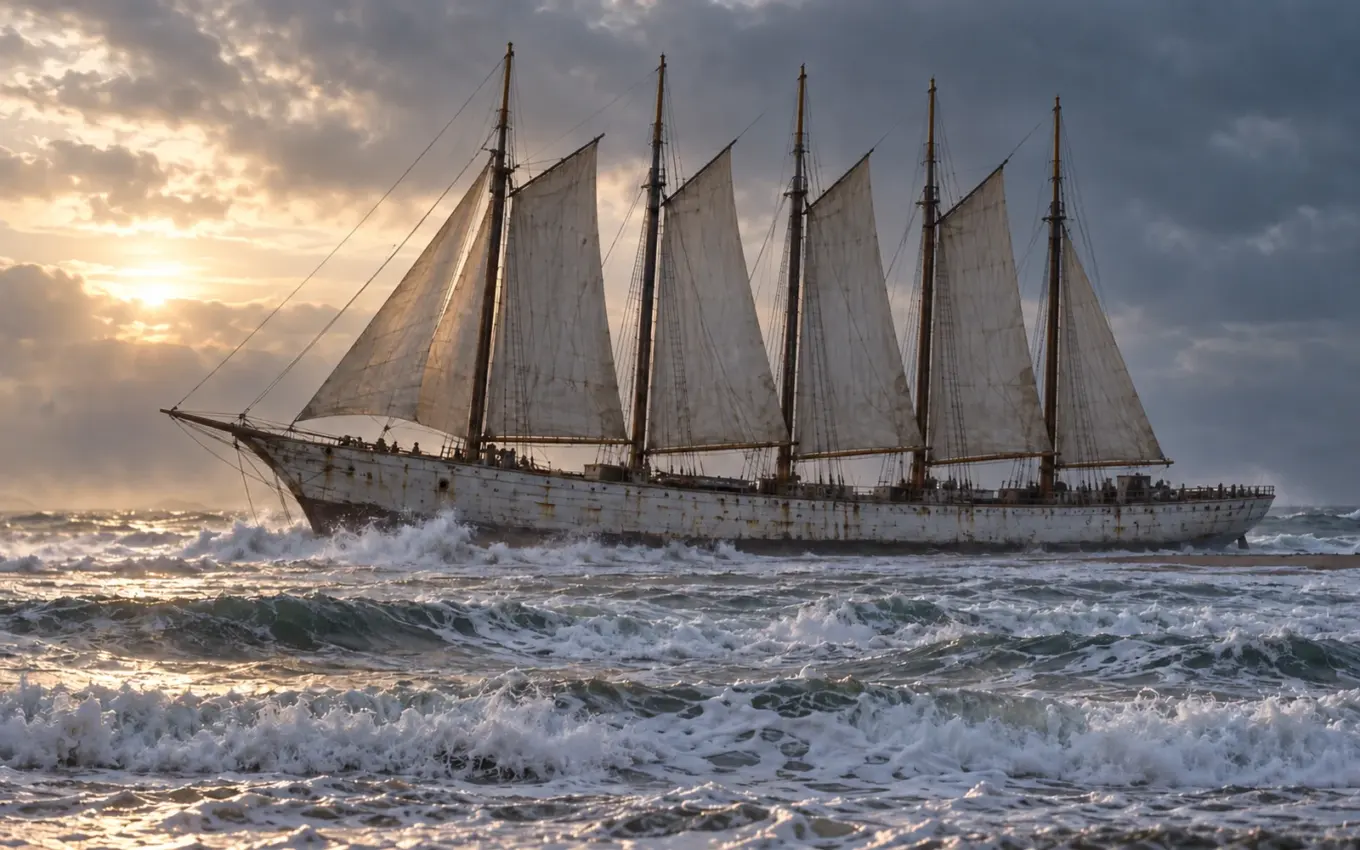
In the Carroll Deering case, the first certainty was that a large sailing ship had reached the shoals. The second certainty took longer to establish: nobody was left aboard.
On January 31, 1921, a Coast Guard lookout spotted the five-masted schooner Carroll A. Deering grounded off Cape Hatteras, North Carolina. Her sails were still set. Rough seas prevented an immediate boarding. For days, the vessel could be seen more easily than she could be reached. [1]
The Last Sightings of the Carroll Deering
Two days earlier, the schooner had passed the Cape Lookout Lightship. A man aboard called out that the ship had lost her anchors. The lightship keeper later thought something about the encounter was unusual: the speaker did not seem to behave like an officer.
Another vessel encountered the schooner on January 30 and noted a peculiar course. The following morning, Deering was on Diamond Shoals. [1]
Those sightings preserve pieces of a journey without preserving the explanation for its end. The reported problem with the anchors may have mattered. The person who called across may have mattered. The route may have mattered. But a detail becoming suspicious after a disappearance does not automatically show what caused it.
The ship had been visible to other people while the events leading to her abandonment were still taking place, or close to taking place. That proximity makes the silence afterward more troubling. There were moments when someone could have looked across the water and seen a working vessel with people aboard.
Then there were no people to ask.
Four Days to Reach an Empty Ship
It was February 4 before a boarding confirmed the schooner’s condition. The boats were missing, along with important navigational equipment and documents. The absence was broader than a crew temporarily going below or taking shelter from the weather.
Food had been left as though a meal had been in preparation. The ship’s master, Captain William B. Wormell, and the other men were gone. [1][2]
A prepared meal is the kind of detail that can overwhelm a mystery. It suggests a sudden interruption because meals belong to routine. But it does not provide a clock precise enough to tell us when the crew left, or establish whether they left in panic.
The missing boats suggest an attempted departure. They do not supply its destination or prove that everyone was in them.
The North Carolina coast was known for dangerous wrecks and difficult rescues. A ship within sight of land could still be separated from it by conditions capable of destroying a small boat. Geography that appears close on a chart may be inaccessible to people in the water. [3]
The men’s absence therefore remained compatible with several very different events. Investigators had a ship and a collection of missing objects. They did not have the people who could explain the relationship between them.
The Message That Seemed to Explain It
Later that year, a local man reported finding a message in a bottle that purported to explain the schooner’s capture. It appeared to offer what the wreck had not: words from someone associated with the missing crew.
The message was exposed as a hoax. [1]
That episode is a particularly bitter part of the story. An unexplained disappearance creates a demand for any surviving voice. A false message can occupy that space, briefly turning speculation into something that looks like direct testimony.
Once exposed, it does not leave the investigation exactly where it was. Time has been spent. Attention has been directed. Families and readers have been given an answer and then had to lose it again.
The Carroll Deering investigation considered dramatic explanations, including piracy and mutiny. None was established as the solution. The ship was eventually destroyed as a navigational hazard, removing the stranded hull from the coastline without resolving the disappearance. [2]
The record would retain a wreck, a hoax and a group of men who did not return.
The Missing Journey Between Ship and Shore
The phrase ghost ship can make an abandoned vessel seem supernatural. It is also an efficient way to hide the people who made the event a tragedy. A ship is not frightening because it lacks a crew in the abstract. It is frightening because a specific crew had been there, doing the work needed to keep it moving, and something ended that arrangement.
We do not know the final sequence aboard Deering. We do not know whether the people who left believed the shore would be reachable. A boat going over the side could have represented escape, a precaution or a last chance.
The coastline eventually received the ship. It did not provide a confirmed account of the people who had sailed her.
The last images in the case remain separated: a man calling across to a lightship, a schooner taking a strange course, a hull held on the shoals while surf prevented anyone from boarding.
When someone finally reached the deck, the questions had arrived before them.
The people who could answer were gone.
Sources and record notes
Record type: Researched nonfiction. Filed: October 15, 2026.
Established facts: Carroll A. Deering was found aground on 31 January 1921. Boarding was delayed by rough seas. The crew, boats and important records were missing. A purported message from the crew was exposed as a hoax.
Uncertainty: Neither mutiny nor piracy was established. A prepared meal does not establish the exact time or cause of abandonment.
- National Park Service — The Ghost Ship of the Outer Banks
- NCpedia — The Ghost Ship Caroll A. Deering: Still an Outer Banks Mystery
- NCpedia — Shipwrecks and the North Carolina coast
Explore the DarkRecord story archive, or read how DarkRecord labels and sources its stories.