The Donner Party did not set out to test how much winter a human being could survive. Its members were travelling toward farms, homes and new lives in California. They needed to cross the Sierra Nevada before the season closed the route.
By the time they reached the mountains in the autumn of 1846, delays had consumed time, provisions and the strength of their animals. Then the snow made the remaining distance almost impossible to cross. [1]
The Donner Party Reaches the Snow
The westward journey had been difficult before winter became the dominant danger. Members of the group took the Hastings Cutoff, a route promoted as a way to shorten the trip. It instead cost them precious time and resources.
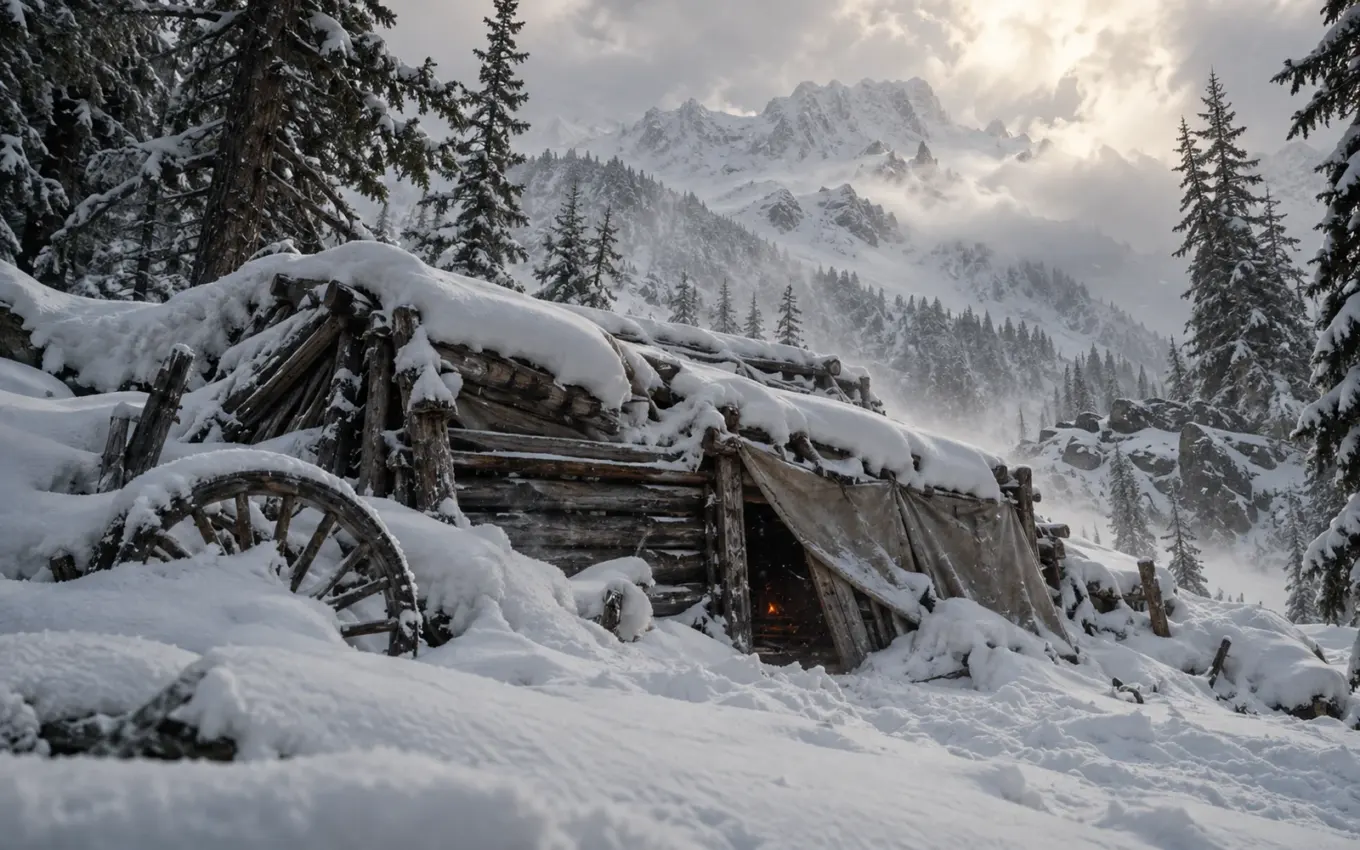
The National Park Service’s account describes exhausted emigrants reaching the region around Truckee Lake in October. Snow trapped them east of the crest. Shelters that had been intended as temporary protection became places in which people would have to endure a season for which they were badly prepared. [1]
The Donner families were separated from the main lake camp at Alder Creek, several miles away. George Donner had been injured, and his wife Tamsen cared for him as his condition worsened. Their young daughter Eliza was among the children trapped in the camp. [2]
On a map, the distance to safety was finite. It had a direction and could be described. In the snow, the same distance demanded food, strength and movement the trapped people were steadily losing.
The Things That Became Food
As provisions dwindled, the camps’ choices narrowed. Animals were killed for food. The National Park Service describes the use of rawhide after more ordinary resources were gone. Some members of the wider party ultimately resorted to cannibalism to survive. [1]
That last fact has dominated the history so thoroughly that the people themselves are often introduced only through it. It should not be hidden, but it should not be allowed to erase everything that preceded it: a difficult journey, failed expectations, families trying to keep children alive and the physical effects of prolonged hunger.
Nor did every member participate. The groups were separated, their circumstances differed and the surviving accounts do not support treating every person as having made the same decisions. California State Parks presents the disaster as the history of a varied emigrant company, not a single undifferentiated act. [3]
The horror lies partly in the slow revision of what seems possible. Something unimaginable at the beginning of a journey can become a question someone is forced to confront after the normal alternatives are gone.
There was no moment at which the entire company stepped together across one clear moral threshold. There were people in different shelters, with different supplies, facing different points at which their bodies could no longer continue without food.
The Route Rescuers Had to Cross
Some emigrants left the camps in an attempt to reach help. Survivors of those desperate efforts brought news that made relief possible. But knowing where people were trapped did not make it easy to bring food to them or get them out.
The rescuers had to cross the same winter landscape. At Mule Spring, deep snow stopped their pack animals. Men continued on homemade snowshoes, carrying heavy loads of provisions. The site became a staging point for successive rescue efforts. [4]
This is the part of the Donner Party story that makes a rescue feel almost as frightening as continued confinement. A person brought out of a starvation camp still had to travel through conditions that had trapped the camp in the first place.
Help could not arrive as a warm vehicle collecting everyone at once. Decisions about who could move, who needed to be carried and what supplies could be taken remained matters of survival.
The camps did not empty in a single triumphant departure. Relief came through repeated journeys, with loss and uncertainty continuing between them.
The Child Who Waited for Her Parents
Eliza Donner was three when the journey began. In March 1847, rescuers took her and her sisters out. Eliza was so weak that she had to be carried. She never saw her parents again.
After reaching safety, the children waited for George and Tamsen to arrive. News eventually came that both had died. Years later, Eliza published a memoir and remained willing to identify herself with the family whose name had become shorthand for the catastrophe. [2]
That perspective changes the ending. The disaster was not only the extremity of what starving adults did. It was also children reaching a safer place and continuing to expect people who would not come.
Some survivors lived long enough to see the story turned into books, public memory and a monument. Their survival did not require them to agree with every sensational version told about them. The record contains different memories, disputed details and people trying to preserve the lives behind a notorious name. [2][3]
The mountains can now be crossed in ways that make the distance look deceptively manageable. That modern view cannot be carried backward into the winter of 1846–1847.
For the trapped emigrants, the route existed but could not be used in the ordinary way. Food was beyond the snow. Help was beyond the snow. The lives they had intended to begin were beyond the snow.
The mountain did not have to move toward them.
It only had to remain closed.
Sources and record notes
Record type: Researched nonfiction. Filed: October 15, 2026.
Established facts: The Donner-Reed emigrants were trapped in the Sierra Nevada in the winter of 1846–1847 after delays on their westward journey. Starvation killed many. Some survivors resorted to cannibalism. Multiple relief efforts brought survivors out.
Uncertainty: Membership and death counts vary according to definitions; the article does not use a disputed total. Not every member participated in cannibalism, and later memoirs have limitations.
- National Park Service — Donner and Reed Wagon Train Incident
- National Park Service — Eliza Donner Houghton
- California State Parks — Donner Memorial State Park brochure
- National Park Service — Mule Spring and the relief parties
Explore the DarkRecord story archive, or read how DarkRecord labels and sources its stories.