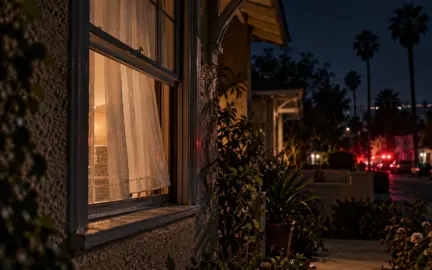
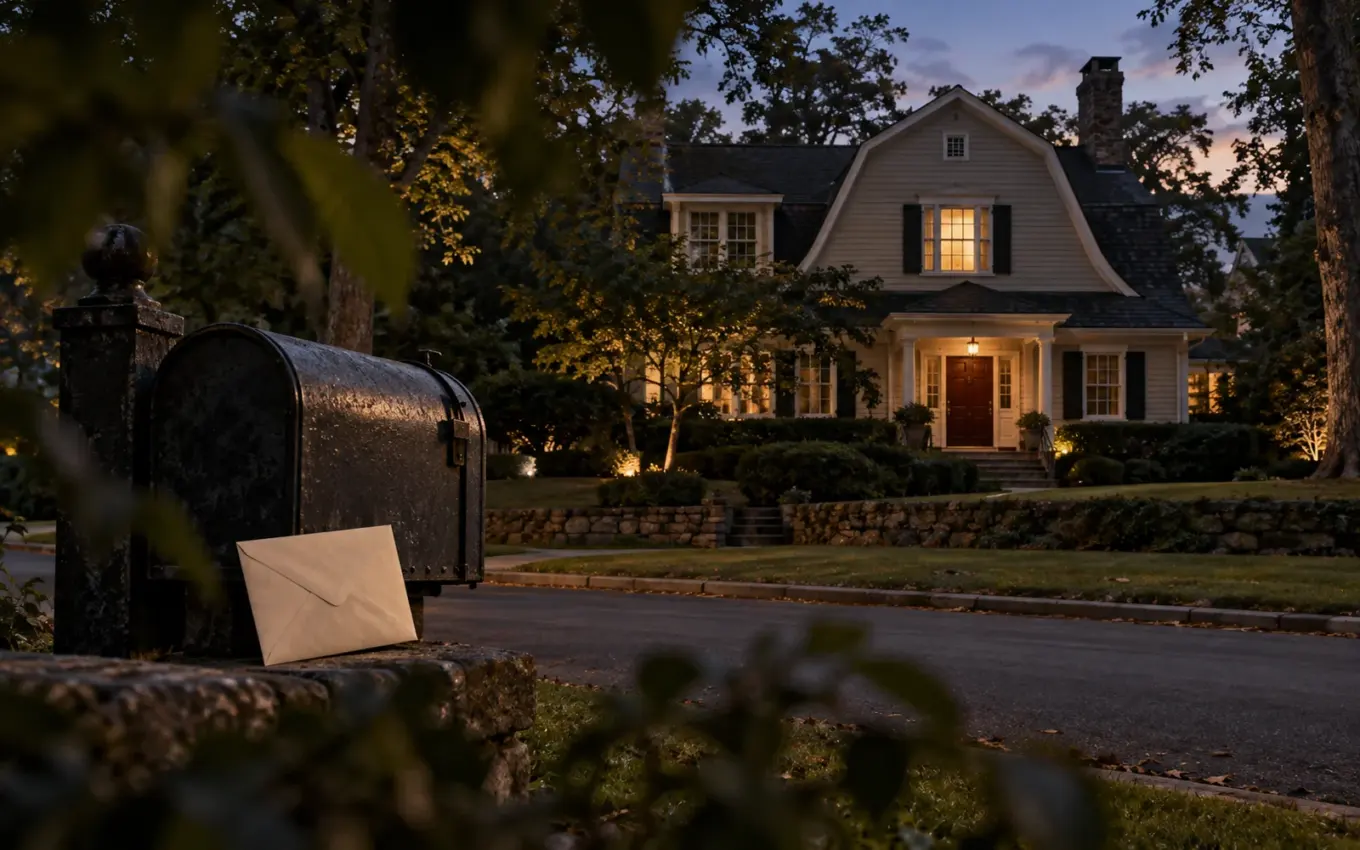
The Watcher house looked like the beginning of a new family life. Derek and Maria Broaddus bought the Westfield, New Jersey, property in 2014. Before they moved in, they received a letter from someone claiming a disturbing relationship with the building.
The writer called themselves the Watcher. The message was not a welcome. It made the house, its windows and the family’s children part of an unknown person’s attention. [1][2]
The First Watcher House Letter
According to the family’s account and the civil complaint that brought the case into public view, the letters began soon after the purchase. The writer claimed to have watched the property as part of a history stretching through earlier generations.
That history was a claim made by the person writing. It was not a verified record of decades of surveillance. But the claim did not need to be proven to frighten the people receiving it. The family had just bought a place they intended to make safe, and someone was already describing it as a possession of their own. [2]
The difference between legal ownership and a stranger’s asserted ownership gave the threats their particular force. The family had keys. The writer claimed a kind of access that could not be measured by keys.
A stranger who says they are watching makes every ordinary line of sight available to the imagination. A window across the street is a window, but it is also a possible place from which someone could look. A passing vehicle remains ordinary until the letter makes it one of many possibilities that cannot be ruled out.
The writer had introduced uncertainty into a place the family had expected to understand.
The Family Who Did Not Move In
The Broadduses did not bring their family to live in the house. In 2015, local reporting described a civil dispute involving the property and the difficulty of selling a home associated with threatening letters. Potential buyers could be frightened by the same uncertainty that had kept the owners away. [1]
The crime therefore reached beyond the moments when a message arrived. A letter could be read, put down and preserved, but its effect could remain attached to rooms, financial decisions and conversations about where the family would live.
There was no need for a visible intruder to stand inside the building. The threat worked by making the absence of an intruder impossible to confirm in a satisfying way. Looking out and seeing nobody would not answer who had written the letter or when another might arrive.
It was also a danger without a known face. A person can take precautions against an identified individual. An anonymous correspondent can borrow the appearance of any person the recipient sees, precisely because the recipient does not know which person to exclude.
That does not make every neighbour a suspect. It explains why unsupported suspicion can become another injury produced by the letters.
The Case Behind the Television Story
The family eventually sold the house in 2019. Reeves Wiedeman, whose reporting brought the case to a wider audience, later discussed the investigation and the emotional consequences in interviews surrounding the television adaptation. The writer’s identity had not been established in those accounts. [3]
The Netflix series added fictional characters and events. Time’s account of the real case distinguishes the threatening correspondence from the dramatized narrative that grew around it. [4]
That distinction is essential here. A tunnel, an invented neighbour’s secret or a staged confrontation may make compelling television. Such details do not become evidence because they are easier to picture than a letter and an unanswered investigation.
The real Watcher house story is already disturbing on a smaller physical scale. It involves people reading words intended to change how they feel inside a building. The act is modest enough to fit through a letter slot. Its consequences are not.
No uncharged neighbour needs to be assigned the role of villain to make the case complete. The failure to establish an identity is part of what happened, not a blank space in which an accusation can safely be invented.
The View Through the Glass
The most effective part of the letters was the writer’s claim to attention. Attention is difficult to prove absent. A householder can check that a door is locked. They cannot check every possible person who might have looked at the house from the street.
That is why the Watcher house remains such a powerful example of fear without a visible attack. An unknown person took features meant to make a home pleasant—rooms, windows, a family’s plans—and described them as opportunities for intrusion.
The building did not have to change. The reader’s understanding of it changed.
There is no established final confrontation in which the family learned which face belonged to the name at the bottom of the letters. The cited investigations leave that question unresolved.
The house could be sold. The correspondence could be placed in a file. The family could attempt to move on.
What could not be easily put away was the invitation to look out through the glass and wonder whether the person who had written was looking back.
Sources and record notes
Record type: Researched nonfiction. Filed: October 15, 2026.
Established facts: Derek and Maria Broaddus received threatening letters after buying a Westfield home in 2014. They did not move their family into it and eventually sold it. The writer’s identity was not established in the cited investigations.
Uncertainty: Claims in the letters are claims by an unknown writer, not verified surveillance history. The account does not accuse neighbours or reproduce invented Netflix plotlines.
- NJ Spotlight News — Family Can’t Sell Home Because of Westfield Watcher
- NOS — Family avoids house after letters from The Watcher
- Vanity Fair — Interview with the original Watcher reporter
- Time — The true story behind The Watcher
Explore the DarkRecord story archive, or read how DarkRecord labels and sources its stories.