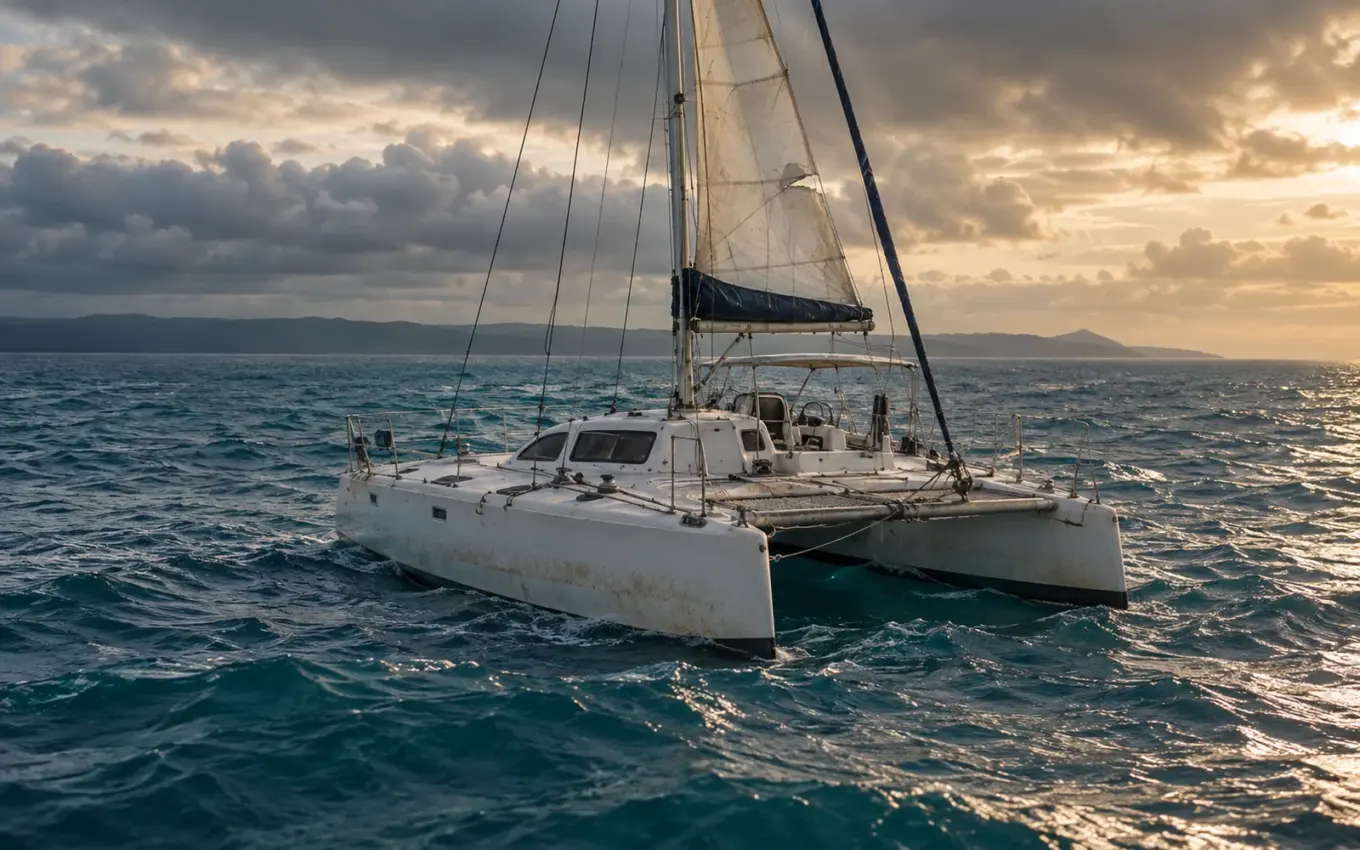
Kaz II was found drifting off northern Queensland in April 2007. The engine was running. The three men who had begun the voyage were missing.
The immediate picture invited a familiar maritime nightmare: a functioning boat, traces of ordinary life and no one aboard to explain the absence. But this case would also produce a coroner’s reconstruction suggesting a terrible chain of accidents rather than an inexplicable disappearance. [2][3]
The Empty Deck of Kaz II
Skipper Derek Batten and brothers Peter and James Tunstead had sailed from Airlie Beach on April 15, intending to take the catamaran around to Western Australia. Days later, an aircraft spotted the boat adrift, and rescuers boarded.
Early reports described the engine running in neutral and a damaged sail. The boat was recovered and taken to Townsville. Investigators examined it while an air and sea search attempted to locate the men. [3]
The running engine was an especially disturbing detail. It suggested continued activity without anyone left to direct it. A machine does not know when the person who started it has gone. It continues until a control changes, fuel runs out or something stops it.
That ordinary mechanical indifference gave the discovery its uncanny appearance. The boat did not need to be damaged beyond repair to have become a place from which human help was absent.
There was no witness aboard when rescuers arrived. The investigation would have to work outward from the vessel, its equipment and the conditions it had encountered.
The Search Beyond the Boat
The search did not locate a surviving crew. By April 22, authorities had suspended the operation. Reporting at the time described investigators’ growing belief that the men had gone overboard in the earlier part of the voyage. [4]
From a distance, the mystery can seem to be why three adults would all leave a boat. That phrasing quietly assumes a shared decision to leave. An accident at sea can remove people in a sequence: one person enters the water, another attempts to help and the situation changes again before anyone can restore control.
The boat can remain available in principle while becoming unreachable in practice. An edge that can be stepped over from above may offer no easy route back from below, particularly while the vessel is moving or the people in the water are exhausted.
Those observations do not prove the precise events aboard Kaz II. They explain why a recovered boat is not, by itself, proof that its crew had a safe alternative they inexplicably refused to use.
The men’s families needed more than the description of an empty deck. They needed a reason to believe the investigation had considered how it could become empty.
What the Coroner Reconstructed
Queensland State Coroner Michael Barnes delivered findings in August 2008. He concluded that the men had died at sea and considered drowning the likely cause. The evidence supported a possible sequence in which one of the brothers entered the water while trying to retrieve fishing equipment, the other went to assist, and Batten may have been knocked overboard by a swinging boom. [1][2]
This is a reconstruction, not footage of the event. Barnes did not have a surviving witness narrating every movement. The finding is therefore best understood as an explanation supported by the available evidence, with the exact sequence retaining uncertainty.
That limitation should neither be hidden nor exaggerated. The existence of unresolved seconds does not mean every proposed explanation is equally plausible. A coronial inquiry can establish a strong account of a fatal accident without producing the kind of complete, continuous scene that a dramatization would show.
The most chilling aspect of the reconstruction is its speed. Each action could have arisen as a response to the previous emergency. Something initially limited could become a situation in which nobody remained aboard to bring the boat back.
The Boat Keeps Going
Kaz II is sometimes called a ghost ship. The phrase is vivid, but it can obscure the practical lesson carried by the evidence: people can be lost from a vessel without the vessel itself being lost.
The inquest also examined matters relating to identification, communication and the search response. Its recommendations were directed at real systems used to recognise vessels and coordinate help. [1]
Those details are less sensational than the initial discovery. They are also part of what distinguishes a researched account from a story built only around the strangest photograph.
The catamaran was brought back. The men were not. A reasonable reconstruction emerged, but no one could restore the moment before the first person entered the water.
There may have been no single decision to abandon Kaz II at all. The boat may have become empty through successive efforts to respond to danger, each one narrowing the chances of getting everyone home.
That possibility does not make the case less frightening.
It makes the running engine easier to understand, and the empty deck harder to look at.
Sources and record notes
Record type: Researched nonfiction. Filed: October 15, 2026.
Established facts: Kaz II was found deserted in April 2007. Derek Batten and brothers Peter and James Tunstead were missing. Queensland’s 2008 inquest concluded they had likely drowned after a sequence of accidents.
Uncertainty: The coroner’s sequence is a reconstruction, not an eyewitness account. Early reports contain conflicting ages and descriptions of a prepared meal; the narrative does not treat these as decisive evidence.
- Queensland State Coroner — Findings into the deaths of Batten and the Tunstead brothers
- ABC News — Missing catamaran trio likely drowned: coroner
- ABC News — Search resumes for crew of abandoned yacht
- ABC News — Search suspended for missing yacht trio
Explore the DarkRecord story archive, or read how DarkRecord labels and sources its stories.