The Monster of Florence murders changed the meaning of the countryside around one of Italy’s most beautiful cities. For years, couples who drove beyond Florence into quiet lanes and secluded places had to live with a new possibility: somewhere outside the car, another person might be watching.
Monster of Florence murders
In August 1968, Barbara Locci and Antonio Lo Bianco were shot while together in a car near Signa. Locci’s young son was present and survived. Her husband, Stefano Mele, was convicted in connection with that crime.
If the story had ended there, the case would have remained a local tragedy. It did not. Years later, investigators connected a .22-calibre Beretta and Winchester ammunition markings to a sequence of murders around Florence. The same weapon appeared to have returned while Mele was in prison.
Privacy Became the Trap
The later victims were typically young couples seeking privacy in parked cars, tents or secluded rural areas. The attacks occurred outside the city, often in places where darkness and distance reduced the chance of interruption.
That repeated setting gave the case its particular terror. The Tuscan countryside is associated with vineyards, stone villages and quiet roads. The Monster case transformed those same landscapes into places where a parked car could feel exposed rather than hidden.
The Same Weapon Returns
Investigators linked the crimes through ballistic evidence associated with a Beretta .22 pistol and Winchester cartridges marked with an H on the base. This repeated forensic signature allowed police to connect murders separated by years.
Some attacks also involved postmortem mutilation of female victims. DarkRecord does not reproduce those details beyond what is necessary to explain the investigative pattern. The significance is that the offender’s behaviour went beyond shooting and displayed a recurring ritualised element.
Years Between the Attacks
The series stretched from 1968 to 1985. Between attacks, investigators chased suspects and theories. The long gaps created a cruel rhythm: a suspect could appear plausible, public anxiety could ease, and then another couple would be found.
In 1985, two French visitors were killed near Florence. Those murders are generally treated as the final double killing in the series.
Trials Without a Final Ending
The investigation eventually focused heavily on Pietro Pacciani. He was convicted in 1994 of multiple murders attributed to the Monster, then acquitted on appeal in 1996. Italy’s highest court ordered a new proceeding, but Pacciani died in 1998 before it could take place.
Mario Vanni and Giancarlo Lotti were later convicted in connection with several of the double murders. Those convictions are part of the legal record, but they did not produce a simple answer to the entire series.
Treccani’s historical review notes the extraordinary complexity of the proceedings, contradictory testimony and the fact that responsibility for all eight double murders has never been cleanly resolved in a single coherent judicial account.
The Gun That Was Never Found
The firearm central to the ballistic theory was never recovered. That missing object sits at the centre of the case like an absent final chapter.
If one gun connected the series, where did it go? Who controlled it across the years? Were all the killings committed by the same person, by multiple people, or by offenders whose roles changed over time? Courts answered pieces of the story, not the whole thing.
A Case Buried Under Theories
Italian investigations produced convictions, acquittals, reopened inquiries and theories involving wider conspiracies. Some are grounded in court records; others move into speculation. DarkRecord does not present the more sensational theories as fact.
What is certain is already enough: sixteen people were killed in eight double murders associated with the series; the same gun and ammunition pattern tied many scenes together; and the full identity and structure behind the crimes remain contested.
The Countryside After Dark
By the 1980s, the phrase ‘Monster of Florence’ had become a public warning. Couples understood the pattern. Police increased surveillance in secluded areas. Newspapers reported each development. Yet the killer’s choice of rural locations created an enormous search problem: countless roads, pull-offs, fields and wooded areas surrounded the city.
The geography allowed the offender to exploit privacy itself. A place chosen because no one was nearby was, by definition, a place where help would be slower and witnesses less likely.
The crimes changed the emotional meaning of those places. A parked car at night was no longer merely private; it could be watched. A quiet road could conceal someone else. The fear attached itself not to one address but to an entire landscape.
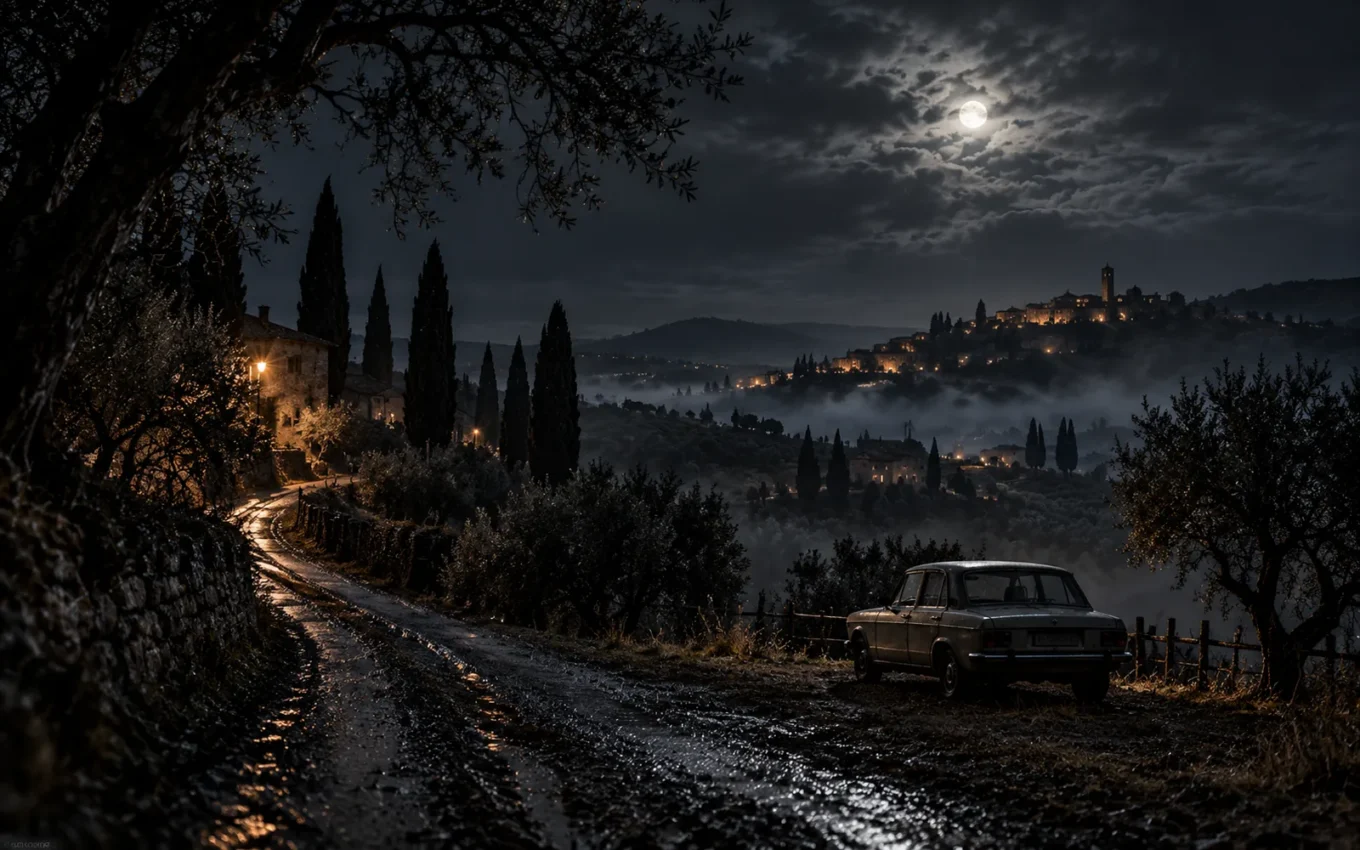
The featured image is an atmospheric illustration, not documentary evidence from the case.
Sources and record
This account relies on Treccani’s review of the Monster of Florence investigation and trials and archival reporting from Corriere della Sera.
Continue with Lake Bodom or The Zodiac Killer.