The Servant Girl Murders made nighttime dangerous in Austin, Texas, during 1885. Before the city became consumed by panic, the first targets were largely African-American women working as domestic servants—people whose lives were often poorly documented by the newspapers that later described their deaths.
Servant Girl Murders
Austin in the mid-1880s was growing, but it was still small enough for repeated nighttime violence to alter the behaviour of the entire city. Many Black women worked as domestic servants and slept in separate quarters near the homes where they were employed.
That arrangement created a vulnerability rarely centred in older newspaper coverage. The first victims were not wealthy public figures. They were working women whose rooms could be separated from the main household and whose lives were less thoroughly documented by the institutions that later preserved the history.
The First Murder
The first murder generally included in the series occurred on December 30, 1884. Mollie Smith, a young Black cook, was attacked at the property where she worked. Her companion was also assaulted but survived.
Months later, another domestic worker, Eliza Shelley, was killed. The intervals did not reassure the city. They suggested that whoever was responsible could disappear for a time and then return.
The Night Attacks Spread
As 1885 continued, the attacks increased. Irene Cross, Mary Ramey, Gracie Vance and others became part of a series that contemporary residents struggled to understand. Several scenes involved victims being attacked at night and moved outside or into yards. Axes or other heavy tools were associated with multiple crimes.
The historical record also reflects the racism of the period. Violence against Black women did not always receive the same urgency as violence against white residents. By late 1885, however, the city could no longer treat the murders as isolated events.
Christmas Eve Changes the City
The series reached a crisis on December 24, 1885, when two white women, Susan Hancock and Eula Phillips, were murdered in separate attacks. Austin’s fear exploded into public outrage.
Officials expanded policing, imposed restrictions and struggled to prevent vigilantism. Pinkerton detectives had already been brought in. None of it produced a conclusive identification of the killer.
Suspects, Tracks and Unproven Theories
Many people were arrested or accused. One later theory focused on Nathan Elgin, a violent man killed by police in 1886 who reportedly had a missing toe. Some crime-scene footprints had been described as unusual, causing later researchers to consider him.
The theory is intriguing but unproven. No court established Elgin as the killer, and historical evidence is too incomplete to present that identification as fact.
Then the Attacks Stopped
After Christmas 1885, the mysterious series stopped. There was no acknowledged capture of the Midnight Assassin.
The abrupt ending helped generate one of the most famous speculative connections in true-crime history: that the Austin killer somehow became Jack the Ripper in London three years later. There is no solid evidence proving that theory. It survives because people dislike an ending in which a killer simply disappears.
The People Behind the Case Name
The most important correction modern researchers have made is to restore names and lives to victims who were too often reduced to job titles. Mollie Smith, Eliza Shelley, Irene Cross, Mary Ramey, Gracie Vance, Orange Washington, Susan Hancock and Eula Phillips were not props in the legend of an unknown killer.
They were people living and working in a city that failed to discover who was attacking them.
Austin Under Curfew and Fear
By the end of 1885, Austin’s response had moved beyond ordinary police work. Officials expanded the force, imposed a midnight curfew, restricted late-night liquor sales and pushed people considered vagrants out of town. Citizens discussed patrols and vigilante action. The killings had become a problem of public order as well as criminal investigation.
The measures reveal the scale of the fear. The city was effectively trying to redesign nighttime behaviour because it could not identify one offender.
Then the murders stopped. Because officials never demonstrated why, none of the new measures can be credited with certainty. The killer may have left, died, been jailed for another offence, changed behaviour or simply decided not to continue. Every ending remains hypothetical.
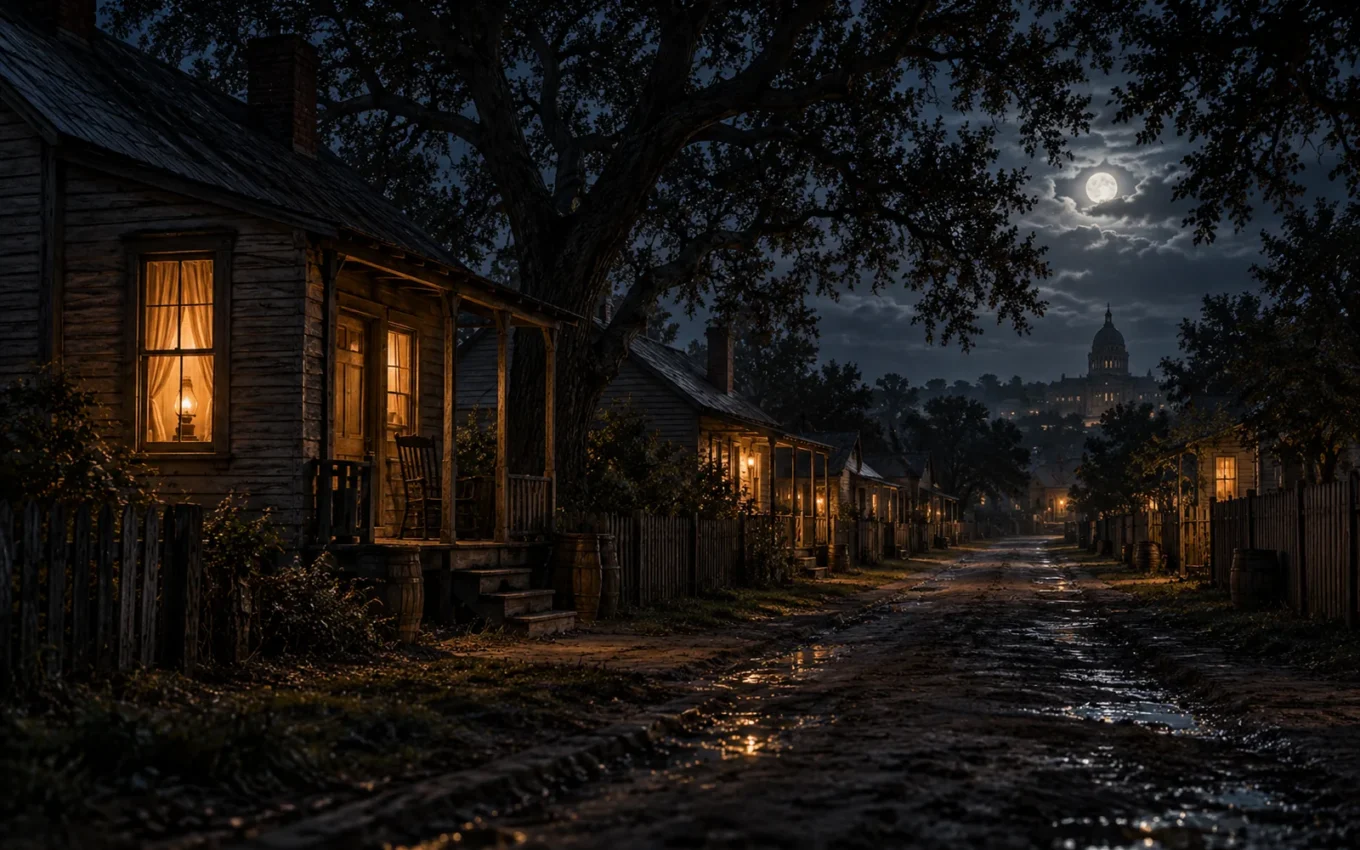
The featured image is an atmospheric illustration, not documentary evidence from the case.
Sources and record
The strongest accessible collection is The Servant Girl Murders historical project, which compiles contemporary newspaper material and victim research, including biographies that restore context to people neglected in older reporting.
Continue with Villisca or The Axeman of New Orleans.