The Lake Bodom murders began as a summer camping trip. Four teenagers reached the shore of Lake Bodom in Espoo, Finland, in June 1960. They had a tent and the uncomplicated plan of spending the night beside the water. By sunrise, three of them were dead and the fourth was badly injured.
Lake Bodom murders
On June 4, 1960, fifteen-year-olds Maila Irmeli Björklund and Anja Tuulikki Mäki went camping with eighteen-year-olds Seppo Boisman and Nils Gustafsson on the shore of Lake Bodom in Espoo. It was Pentecost weekend, and the setting was ordinary enough to feel safe: water, trees, a tent near the shore.
They spent the evening together and eventually settled down. Sometime in the early morning, the campsite changed from a place of privacy into a confined crime scene.
Before Sunrise
Finnish public broadcaster Yle’s archive describes the tent lines being cut and the canvas collapsing. The attacker used both stabbing and blunt-force violence. Björklund, Mäki and Boisman died. Gustafsson survived with serious injuries.
The collapsed tent is the central image of the case because it explains the vulnerability of the victims. Inside a standing tent, a camper has at least a small space to react. A collapsed tent turns fabric and poles into an obstacle. The people inside cannot see clearly what is happening outside.
No invented horror device is required. The attacker had darkness, surprise and a thin layer of canvas between himself and four sleeping teenagers.
The Tent in the Morning
The campsite was discovered later that morning. Police launched an enormous search. Officers, volunteers and members of the public moved through the surrounding woods and shoreline looking for weapons and missing property.
The murder weapon was not found. Some belongings had disappeared. Witnesses reported people in the area, including a man seen near the site, but no observation became the final piece of the case.
The early investigation also suffered from the attention it attracted. Curious people crowded the area. In an era before modern DNA processing and strict scene-control protocols, every unnecessary footprint and handled object reduced the possibility of a clean forensic reconstruction.
Finland Searches for the Person at the Lake
The murders became one of Finland’s defining criminal mysteries. Police questioned many people and followed tips for years. Suspects emerged and faded. Rumours grew around local men, hospital patients and other figures who could be made to fit pieces of the story.
The problem was always the same: suspicion was easier to create than proof.
Decades Later, the Survivor Is Accused
More than four decades later, the case changed dramatically. In 2004 police arrested Nils Gustafsson, the sole survivor. Prosecutors argued that new interpretations of the evidence pointed toward him.
The trial drew enormous attention because it promised something the case had never delivered: an answer. In 2005 the court rejected the prosecution’s case and acquitted Gustafsson. The verdict returned Lake Bodom to its original state—a triple murder with no legally established killer.
People Seen Near the Shore
Lake Bodom was not completely deserted. People moved around the area that morning, and investigators collected sightings that appeared potentially important. Some witnesses described a man near the campsite or moving away from the area. Years later, those memories became central to competing theories, but memory is fragile—especially after a national crime has been discussed repeatedly in newspapers, broadcasts and police interviews.
The only surviving camper could not provide a simple identification that solved the case. Gustafsson said he had little memory of the attack. That absence created a vacuum that later speculation filled.
The case became a struggle between physical evidence, witness memory and theory. Each generation believed a new technique might finally resolve it. Instead, the lake kept returning the same answer: not enough.
What Disappeared With the Killer
Investigators did not have the luxury of treating the campsite as a sealed puzzle. Personal property was missing, and search teams spent days examining shoreline, woods and water. The absence of the weapon and some belongings meant the attacker may have carried evidence away from the scene.
In an outdoor case, every missing item matters twice: first as possible motive or trophy, and second as something that could have retained fingerprints, blood or other trace evidence. At Bodom, those absences became permanent gaps in the reconstruction.
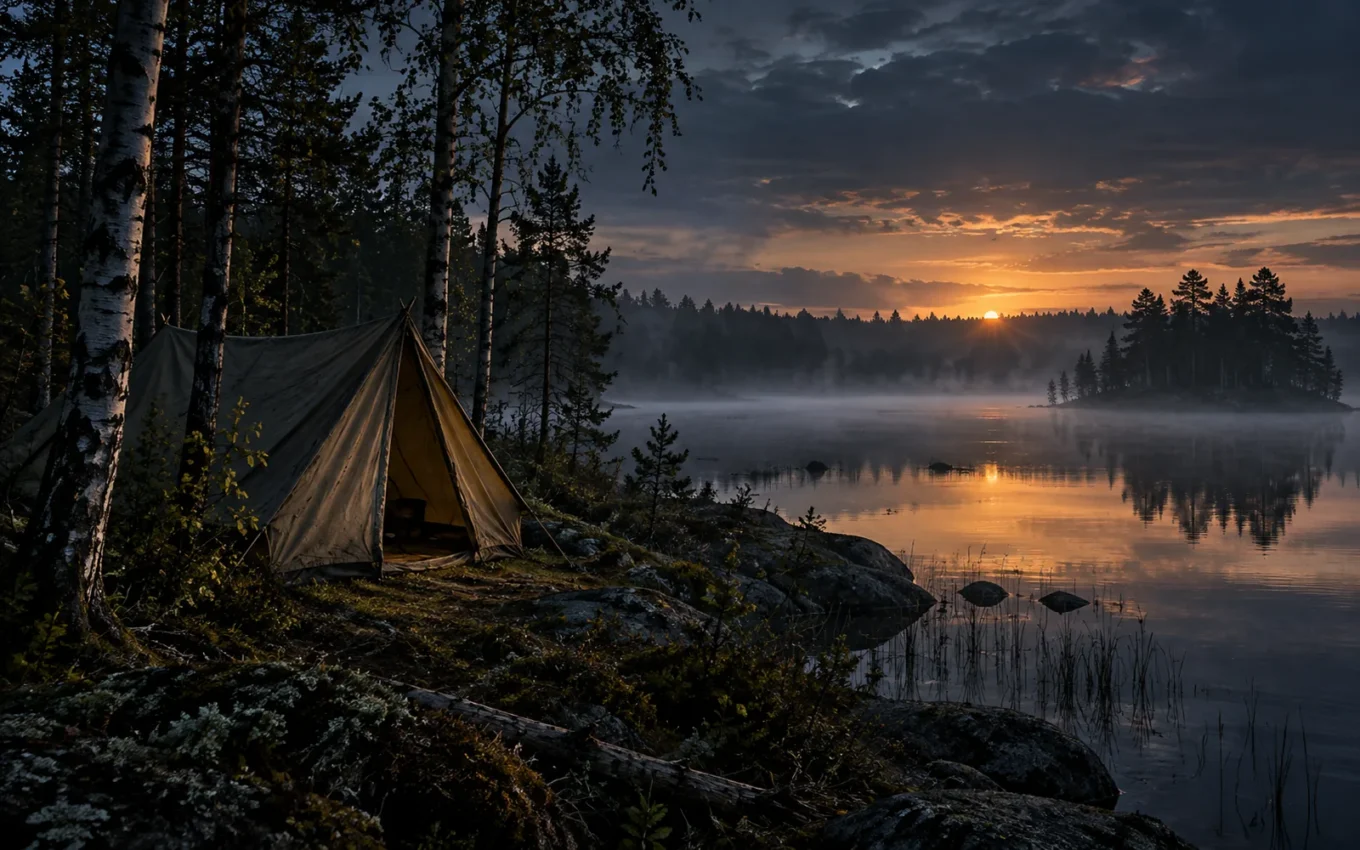
The featured image is an atmospheric illustration, not documentary evidence from the case.
Sources and record
This account relies heavily on Yle’s archival history of the Bodom investigation, including the 1960 search and the later trial, and on Yle’s preserved contemporaneous material.
Continue with Cabin 28 or The Monster of Florence.