
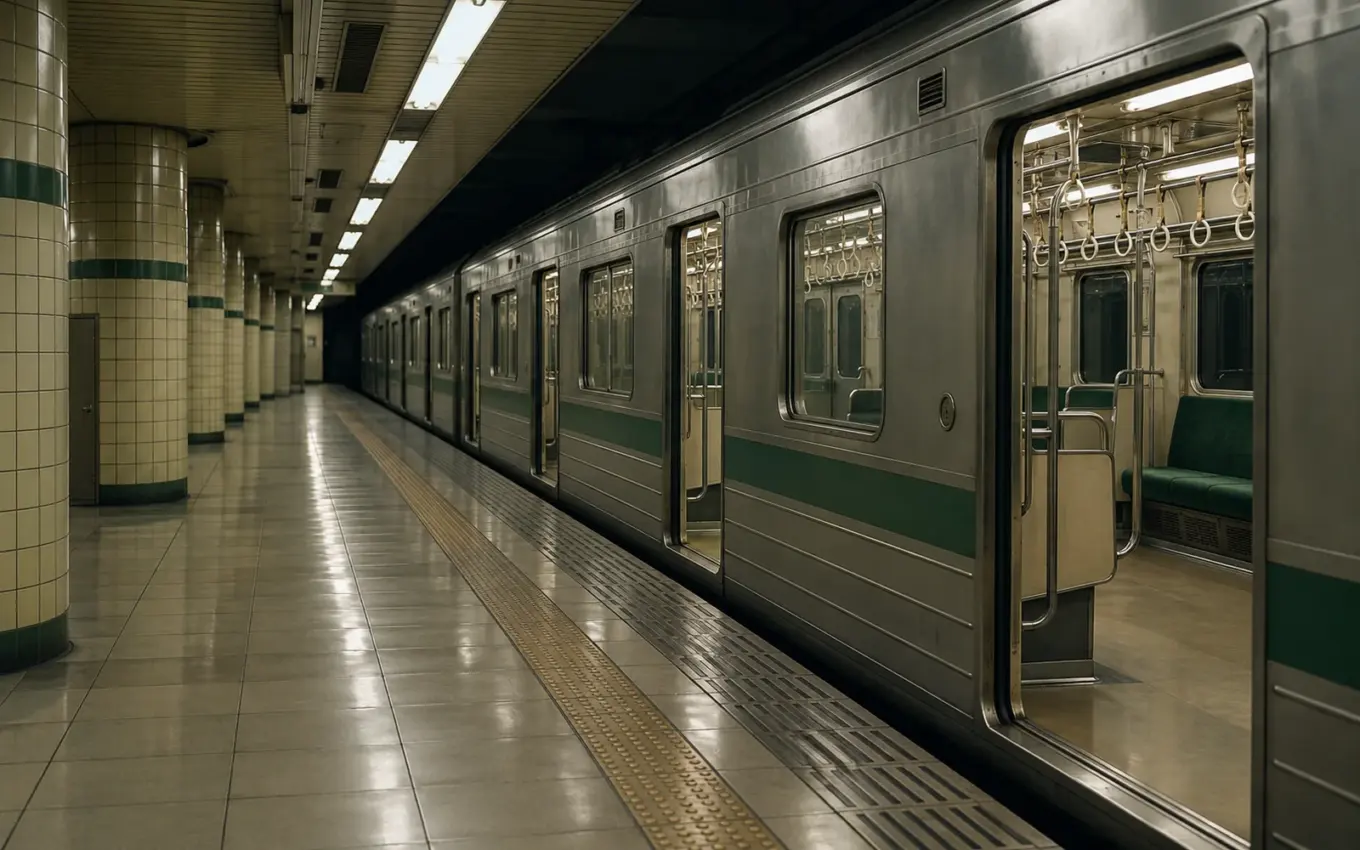
The Tokyo subway sarin attack entered one of the world’s busiest transport systems during the morning commute on 20 March 1995. Passengers were travelling to work through a network built around order, speed and routine. A coordinated chemical attack turned that routine into a medical emergency whose cause was not immediately apparent.
Fourteen people ultimately died, and thousands were affected. The attackers belonged to Aum Shinrikyō, a religious organisation whose internal violence had already developed into a campaign of murder. The catastrophe forced Japan to confront a disturbing question: how had a group presenting itself as a spiritual movement acquired the capacity and intention to attack an entire city?
The Tokyo subway sarin attack unfolds
The attack struck trains serving central Tokyo during rush hour. Sarin, a highly toxic nerve agent, was released into the transport system. People became ill across multiple locations, leaving railway staff, emergency services and hospitals to recognise that apparently separate incidents belonged to the same deliberate assault.
Japan’s National Police Agency white paper from 1995 records the investigation as it unfolded. It is a valuable contemporary source, although its early casualty figures reflect what authorities knew then. Later deaths and revised assessments mean those figures should not be mistaken for the completed historical toll.
The setting amplified the confusion. A subway is a moving network: trains leave stations, passengers change lines and sick people emerge at different points on the surface. An attack inside it can disperse both victims and information. What looks like a local incident at one station may be one fragment of a much larger emergency.
A movement with a history of violence
Aum’s leader, Shoko Asahara, whose original name was Chizuo Matsumoto, cultivated religious authority while the organisation developed a secret criminal apparatus. The subway attack was not its first lethal act. In 1989, lawyer Tsutsumi Sakamoto, who was challenging the group, was murdered along with his wife and infant son.
The historical timeline published by Nippon.com places those killings alongside the 1994 sarin attack in Matsumoto and the subsequent Tokyo operation. Read in sequence, the incidents show an escalation rather than a sudden, unprecedented departure from peaceful activity.
That history makes the case particularly disturbing. The organisation’s danger did not lie solely in unusual beliefs. It lay in the use of secrecy, obedience and violence to protect its leadership and attack perceived enemies. Religious language supplied a framework in which criminal orders could be presented as obligations. The result was a community in which dissent could carry consequences far beyond exclusion.
The warning in Matsumoto
The sarin release in Matsumoto in June 1994 should occupy a central place in the story. It demonstrated that civilians in Japan had already been exposed to a deliberate nerve-agent attack before the Tokyo subway was targeted. The later catastrophe therefore raised questions about recognition, intelligence and the ability to connect evidence across incidents.
A 2025 retrospective drawing on the account of investigation chief Takashi Kakimi examines why the subway attack was not prevented. That question is more useful than treating the crime as a piece of inexplicable evil. Prevention depends on identifying preparations and making decisions before the full significance of the evidence is obvious.
The distinction also avoids false hindsight. Investigators working before an attack do not possess the clarity available after it. Nevertheless, the existence of earlier crimes means institutional decisions can and should be examined. A perpetrator’s responsibility and the public interest in better prevention are compatible parts of the same account.
Deaths that did not end in 1995
Older reports commonly give the death toll as 12 or 13. The later total is 14: a woman who had suffered severe effects from the attack died in 2020. The changing figure illustrates how a disaster’s consequences can continue long after its anniversary becomes a fixed date on the calendar.
Associated Press’s thirtieth-anniversary reporting records that later death and the continuing difficulties faced by survivors. It also follows Shizue Takahashi, whose husband, a deputy stationmaster, was killed. Her campaigning helped keep victims’ experiences visible beyond the criminal proceedings.
For survivors, a verdict did not necessarily restore health, employment or a feeling of safety on public transport. The attack entered ordinary life through the morning commute; its aftermath could return through an ordinary station, a medical appointment or a bureaucratic demand for proof of injury. These are less dramatic scenes than an emergency evacuation, but they explain why the event never became simply a completed news story.
The trials and the city that continued
Asahara was arrested in May 1995. Long investigations and trials exposed the organisation’s crimes. In 2018, he and 12 other convicted Aum members were executed. The end of those sentences closed a major legal chapter without ending the needs of victims or resolving every question about prevention.
The National Police Agency’s later English-language review places Aum within Japan’s response to terrorism. Its account should be read alongside the survivor record: one describes the state’s responsibility to investigate and protect, while the other reveals what protection’s failure meant inside individual lives.
Tokyo’s trains continued to run, and millions of people returned to the same platforms. That continuity can look like recovery from a distance. The more difficult truth is that a city can resume its rhythm while some of its residents remain permanently caught in the morning when an unseen weapon travelled alongside them.