
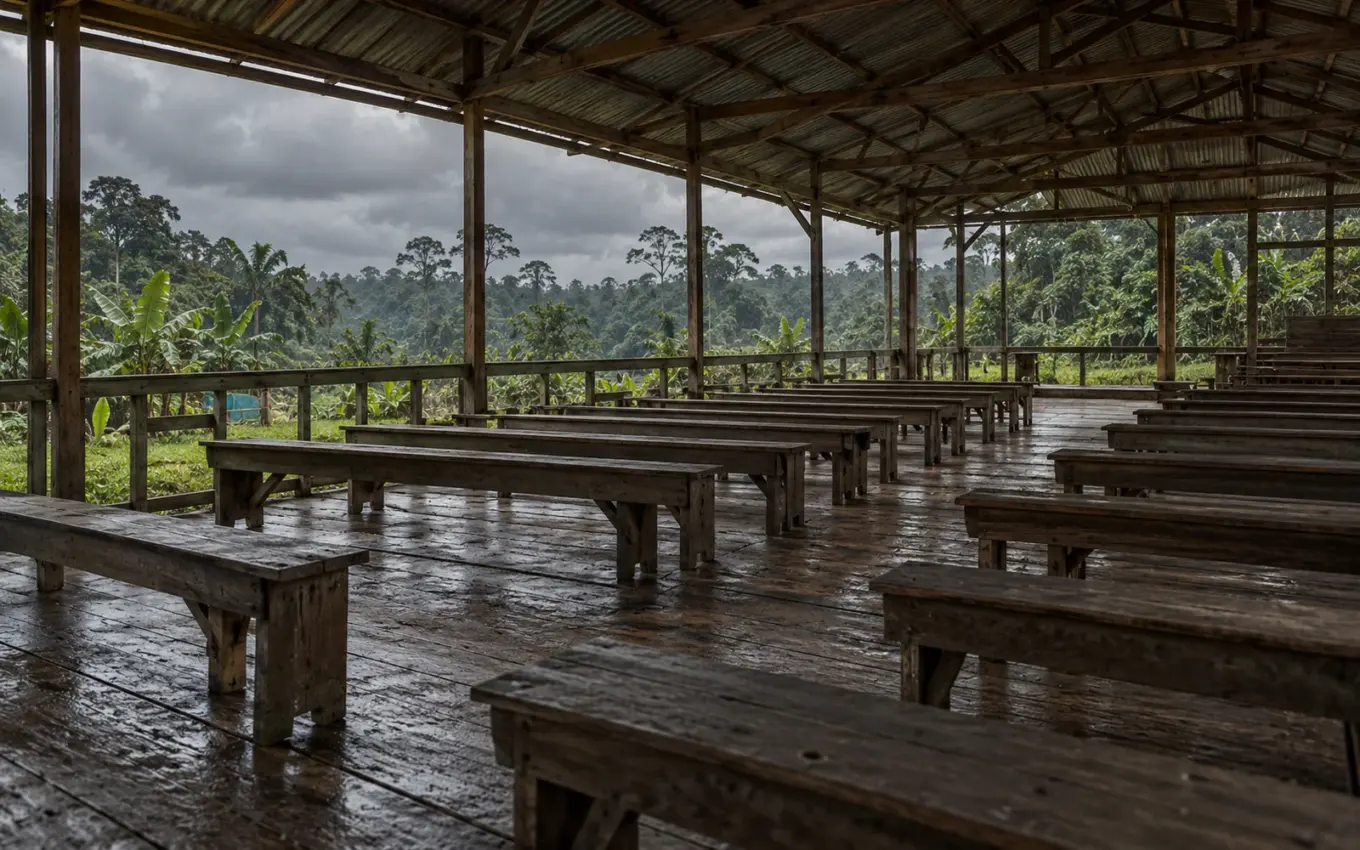
The Jonestown massacre did not begin with an isolated community suddenly choosing to die. It followed years of increasing control, reports of abuse and a growing struggle over whether members of the Peoples Temple could leave. On 18 November 1978, the crisis ended in the deaths of 918 people at three locations in Guyana.
The images that reached the world were almost impossible to absorb. Yet the most unsettling part of the story lies behind the photographs: a movement that had promised belonging and social justice had placed hundreds of families within reach of a leader who treated departure as betrayal. When the final emergency came, even an American congressman’s presence could not guarantee a safe way out.
Before the Jonestown massacre
Jim Jones led the Peoples Temple, a religious and political movement whose American membership included people drawn to its commitment to racial integration and communal support. The settlement in Guyana offered the possibility of building that alternative society far from the United States. Geographic distance also made independent scrutiny and ordinary departure much harder.
By 1978, relatives and former members were raising serious allegations. The FBI’s account of the investigation describes reports of confinement, mistreatment and rehearsals for collective death. California congressman Leo Ryan decided to visit and investigate concerns involving people who had followed Jones from the San Francisco area.
The distinction between the movement’s public promise and these allegations is essential. People did not enter the community with identical motives or equal knowledge. Some had followed relatives. Some believed they were participating in a worthwhile political experiment. The children had no meaningful choice in the arrangements adults made around them. A single label cannot explain all of those lives.
The visit that became an attempted escape
Ryan travelled to Guyana with a delegation that included concerned relatives and journalists. During the visit, some residents asked to leave with him. Their requests brought the central question into the open: would the community’s leadership allow people to withdraw their loyalty and depart safely?
The contemporaneous investigative records preserved by San Diego State University document the congressional visit and the attack that followed. On the afternoon of 18 November, people preparing to leave gathered at the Port Kaituma airstrip. Armed Temple members attacked the departing group. Five people were killed there, including Ryan; others survived with injuries.
The airstrip transformed a possible route to safety into a second crime scene. Those waiting to fly out were no longer simply witnesses to allegations about a distant settlement. They were the targets of violence intended to prevent escape and silence outside scrutiny. For the people who survived, the attack also separated them from relatives and friends whose fate at Jonestown was still unknown.
What happened inside the settlement
Back at Jonestown, Jones directed a mass poisoning. Hundreds of children and adults died. Jones himself was found dead from a gunshot wound. The full circumstances of every individual death cannot be reconstructed with equal certainty, and that limitation matters when describing the adults’ final actions.
The SDSU archive’s assessment of the final day explains why the familiar phrase “mass suicide” is incomplete. Children were murdered. Adults faced a coercive environment, and surviving evidence does not support a simple, universal account of free and informed consent. Nor does it justify inventing an identical last experience for everyone in the settlement.
That uncertainty does not make the event less criminal or less devastating. It places an obligation on the storyteller to distinguish what is established from what remains difficult to recover. A recording, a photograph or a later witness account can illuminate part of an event without giving a complete view of every person present.
The numbers belong to three places
The total of 918 includes 909 people at Jonestown, five at Port Kaituma and four in Georgetown. Treating all 918 as deaths inside the settlement erases the separate killings and obscures the sequence of events. The archive’s memorial list records the victims by name and location rather than leaving them as a single overwhelming number.
More than 300 children were among those who died at Jonestown. Their presence makes glib references to unquestioning followers especially cruel. Infants and children could not assess a leader’s claims, arrange independent transport or consent to their own deaths. Their inclusion is central to understanding the massacre, not a footnote to an adult political or religious story.
Identification and repatriation brought another ordeal for families. The catastrophe had occurred far from many victims’ homes, and early information was confused. A relative seeking a name on a list needed certainty about one person, even while governments and news organisations were trying to comprehend the scale of the entire disaster.
What survived the attempt to end the story
The assassination of a member of Congress gave the FBI a clear investigative role. Its released RYMUR files preserve the investigation into Ryan’s murder and the associated deaths. The surviving record also includes testimony, correspondence and the work of relatives determined to recover lives from the shadow of Jones.
Those materials resist the idea that Jonestown can be explained by one sinister personality alone. Jones bore responsibility for the control and violence he directed, but the history also concerns isolation, fear, institutional failure and the difficulty of helping someone whose community has become dangerous.
The last word should not belong to the leader who tried to make himself the centre of every life around him. Jonestown’s victims had occupations, relationships, convictions and futures before 18 November. Remembering those ordinary human dimensions restores something the massacre sought to destroy: the right of each person to exist as more than a follower in another man’s story.