The Hammersmith Ghost case ended with a real body in the street. The man who died was not an apparition, a disguised attacker or an intruder. Thomas Millwood was a bricklayer wearing the white clothes of his trade.
On January 3, 1804, Francis Smith encountered him while looking for the supposed ghost that had frightened the neighbourhood. Smith fired a gun. Millwood’s ordinary journey home became the fatal conclusion of a panic he had not created. [1]
The Hammersmith Ghost Patrols
In the closing months of 1803, people around Hammersmith reported seeing a white figure near the churchyard and surrounding lanes. Some described alarming encounters. As the stories spread, residents began treating the figure as a threat that might be met in person after dark.
Armed patrols formed. Smith, an excise officer, was among those who went out looking for the supposed apparition. [1]
The danger in that arrangement is visible before the shooting occurs. A person carrying a weapon has already been given an explanation for an indistinct shape in the dark. The explanation may arrive faster than recognition of the person standing there.
Once a community expects to see a particular frightening thing, an ordinary detail can be recruited into the expectation. White clothing stops being only clothing. A person walking at night becomes a possible encounter with the story everyone has been discussing.
None of the reports establishes that a supernatural being was present. They establish that people were frightened enough to act.
The White Clothes
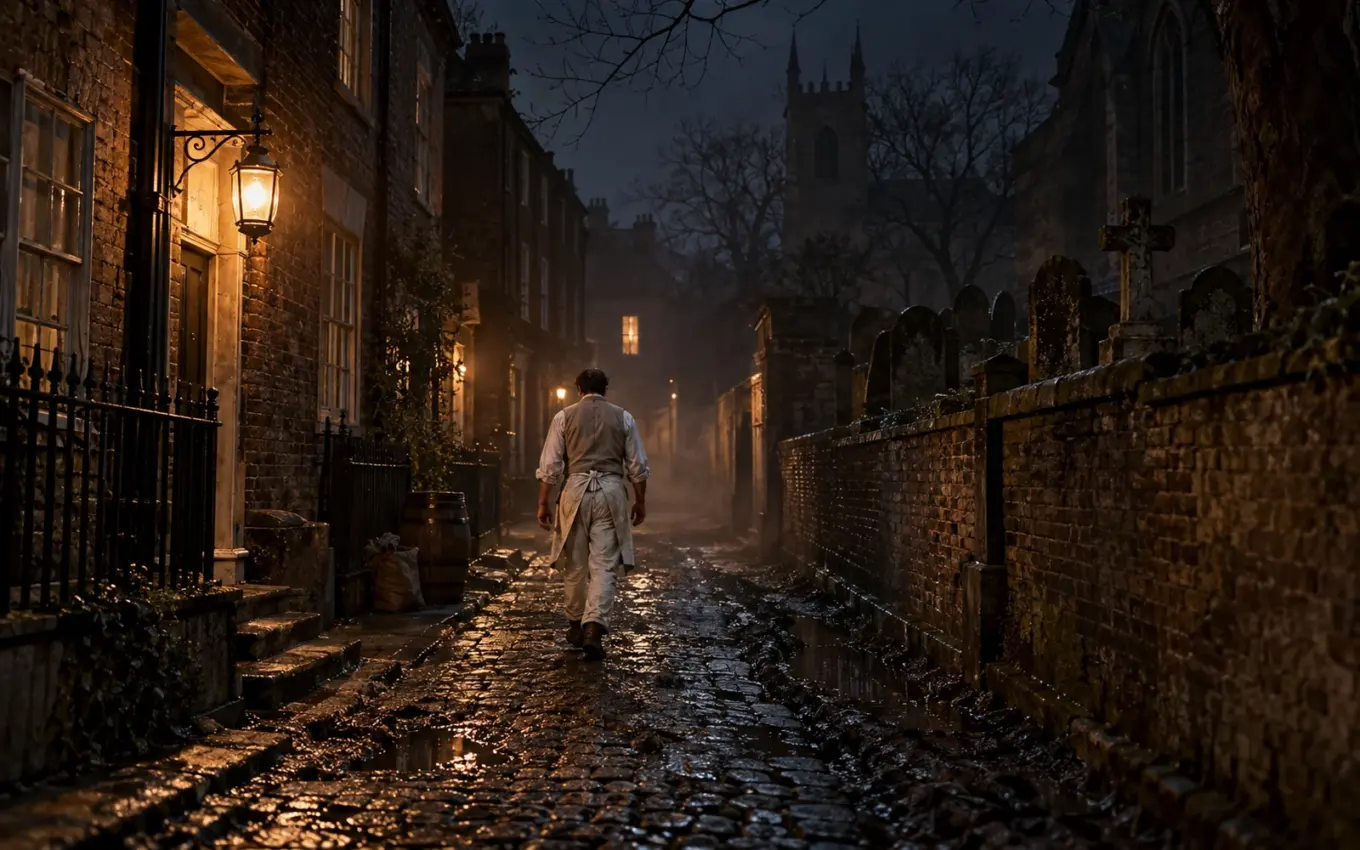
Millwood’s work required clothing that would not have been unusual to anyone seeing him in the right context. At night, in a place primed by rumours of a white apparition, that same clothing became dangerously legible in the wrong way.
Historical accounts describe him returning from a visit to family. The fatal encounter took place after eleven at night. People who knew him were close enough for the shooting to become an event with witnesses to its immediate aftermath, not a disappearance into folklore. [2]
The early Newgate account of the case makes the error painfully plain: a working man was killed because the clothes associated with his occupation were read as the costume of something else. [2]
What makes the scene frightening is not uncertainty about whether Millwood was human. The evidence allows no doubt about that. The horror lies in the fact that his identity did not protect him from someone else’s expectation.
He did not need to participate in the ghost story to become its victim. Walking through the setting in the wrong clothes was enough.
The person hunting a threat had become the threat.
A Murder Trial After a Ghost Story
Smith was prosecuted for murder. The court had to consider the act he had committed, rather than allow the surrounding belief to turn it into a supernatural exception. He was convicted and sentenced to death, with the sentence subsequently commuted. [1][2]
The case later attracted legal discussion about mistaken belief and responsibility. The arguments outlived the panic that had produced them. Its immediate human meaning is simpler: a belief sincerely held by one person can still have a catastrophic consequence for another.
A court proceeding also changes the texture of the story. The language of haunting gives way to testimony, clothing, distance, a weapon and the death of a named person. The facts do not need a ghost to explain the result.
Later versions have incorporated accounts of pranksters and confessions about impersonating the apparition. Such reports may explain some of the alarm. They do not provide a reliable single explanation for every story that circulated. The historical bibliography assembled by Dark Histories shows how the event passed through newspapers, trial records and later collections. [3]
A popular explanation for the haunting should not displace the well-established explanation for the death.
When the Story Arrived First
The Hammersmith Ghost is sometimes remembered as an amusing example of people believing in an apparition strongly enough to try to shoot it. That framing makes the victim disappear a second time. Millwood was not a comic misunderstanding. He was a man killed on his way home.
The frightening mechanism in the case is entirely recognisable without accepting the original ghost reports. Rumour supplied a shape. Repetition supplied confidence. Darkness reduced the available information. A weapon made a mistaken conclusion irreversible.
Each part reinforced the others. People went out because the story frightened them; their patrols made the threat seem serious; a white figure then appeared in an environment already organised around finding one.
The real person inside that shape had no opportunity to correct the whole chain of assumptions before the consequence arrived.
What survives is therefore both a historical ghost panic and a documented killing. The former explains the atmosphere. The latter is the event that must remain central.
There was a figure in white in the lane that night.
He was wearing his work clothes, and he should have been allowed to walk home.
Sources and record notes
Record type: Researched nonfiction. Filed: October 15, 2026.
Established facts: Francis Smith shot bricklayer Thomas Millwood on 3 January 1804 during the Hammersmith ghost panic. Smith was convicted of murder; his death sentence was commuted.
Uncertainty: Reported apparitions are historical claims, not proof of a ghost. Later anecdotes and prankster accounts do not securely explain every reported sighting.
- Wikipedia — Hammersmith Ghost murder case (secondary chronology and references)
- Wikimedia Commons — 1840 New Newgate Calendar, Francis Smith page
- Dark Histories — A Shot in the Dark, source bibliography
Explore the DarkRecord story archive, or read how DarkRecord labels and sources its stories.