Dr Crippen boarded a ship in 1910 at a time when distance could still appear to offer a decisive advantage over the police. An ocean crossing separated a suspect from the place where a woman had disappeared. What helped undo that advantage was information travelling faster than the ship itself.
The wireless message became famous. Before it was sent, however, people in London had refused to accept the explanation for the disappearance of music-hall performer Belle Elmore. Their concern began the investigation that reached across the Atlantic.
Dr Crippen and the woman who disappeared
Belle Elmore, whose name was Cora Crippen, vanished from the couple’s home at Hilldrop Crescent in north London in 1910. Her husband, Hawley Harvey Crippen, offered explanations that did not satisfy people who knew her.
The National Archives’ catalogue of the crime-scene material identifies the address and the investigation into her murder. A modern account introduced through the Archives’ publishing catalogue also draws attention to the female friends who sought an investigation rather than allowing the husband’s version to close the matter.
The distinction is important. A disappearance can remain private if the person most closely associated with the missing individual is allowed to supply the only account of where they went. Elmore had relationships outside her marriage. People within those relationships noticed her absence and continued to ask questions.
What was found beneath the house
Police eventually discovered human remains buried at the property. The discovery transformed the inquiry from a search for an explanation of a disappearance into a murder case. Crippen had left Britain with Ethel Le Neve, his employee and partner.
The remains could not explain themselves. Investigators needed to establish their identity and connect what had been found to the person who was missing. Forensic examination became central to the prosecution, with pathologist Bernard Spilsbury giving evidence at the trial.
The Wellcome Collection’s description of Spilsbury’s surviving papers and related materials identifies the Crippen case among the investigations represented in the broader forensic archive. Such material matters because a famous expert’s reputation is not a substitute for examining what evidence the expert actually considered.
A captain notices his passengers
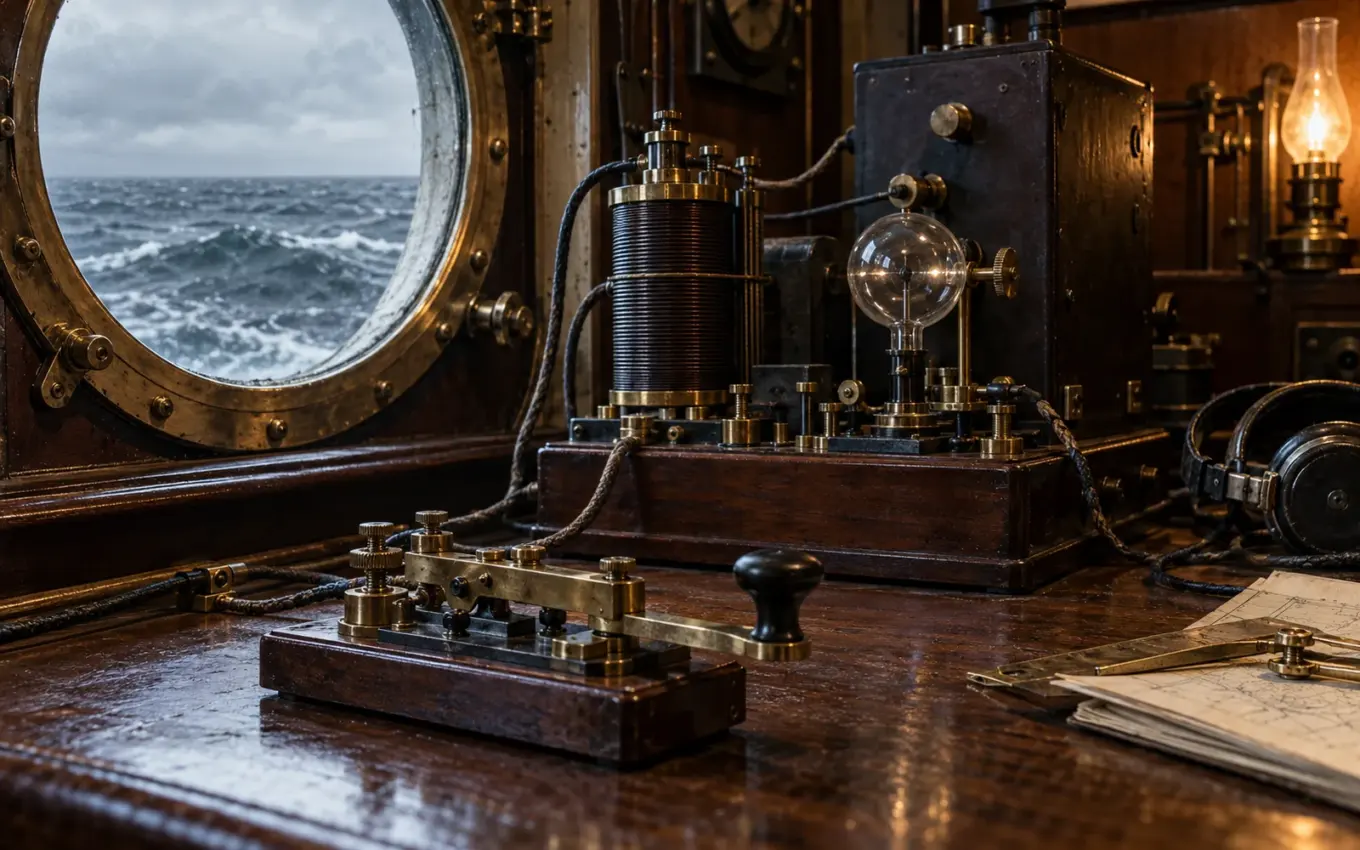
Crippen and Le Neve were travelling aboard the Montrose, bound for Canada. Captain Henry Kendall became suspicious of two passengers and used the ship’s wireless to contact the authorities. His recognition placed information from the British manhunt aboard a vessel already at sea.
The Royal Museums Greenwich account of Kendall’s role describes the message and the race that followed. Inspector Walter Dew travelled on a faster ship to intercept the Montrose in Canada. The ocean had not stopped the pursuit. It had become the route along which the pursuit was organised.
For an offender relying on distance, the change was profound. A ship could carry a person away from the immediate reach of local police while simultaneously carrying a means of reporting where that person was. The same voyage that appeared to provide escape could supply the authorities with a predictable destination.
The arrest and the limits of the famous chase
Crippen was arrested and returned to Britain. Kendall later included the episode in his own account of his life at sea, described in the Royal Museums Greenwich record of his memoir. The captain’s contribution became a landmark in the public history of wireless communication.
Yet the arrest did not prove the murder by itself. Running from an investigation, travelling under an assumed identity or being recognised by a captain can be important evidence. None can replace the legal task of connecting a defendant to the death being prosecuted.
Crippen was tried, convicted and executed in 1910. Le Neve faced separate proceedings and was acquitted. Her outcome must not be rewritten simply because the two had travelled together. The prosecution and verdict concerning one person do not automatically establish the guilt of another.
A contemporary report published by The Spectator on 29 October 1910 records the murder conviction and Le Neve’s later acquittal. It also criticises the sensational publicity surrounding the case. That complaint is a revealing part of the historical record. Concern about turning a murder into entertainment did not begin with modern television or social media. Even while the wireless pursuit was being celebrated, observers could see the risk that the technological spectacle would overshadow the people and evidence at the centre of the trial.
The missing woman behind the technological triumph
The case is frequently remembered as a triumph of modern detection: a ship, a wireless signal and an inspector arriving ahead of his suspect. That is a compelling sequence, but it begins too late if it excludes the people who pressed for Elmore’s disappearance to be taken seriously.
They had no wireless set capable of revealing what happened in the house. They had knowledge of a person and reasons to doubt the account supplied in her absence. The investigation advanced because those doubts were not allowed to remain a private inconvenience.
The chase across the Atlantic brought the case an ending that could be reported around the world. The cellar gave it a darker centre. One location showed what new communication could achieve; the other showed how much could be concealed inside a familiar home. The message that helped catch Crippen travelled quickly. The concern that set the investigation in motion began with people asking why their friend had stopped appearing at all.