The BTK killer spent years trying to control what other people knew about him. He named himself, sent communications and chose when to disappear from public attention. In 2005, one of those attempts to control the story supplied investigators with a clue he had not intended to reveal.
It was not a dramatic confession. It was information left on a computer disk. After three decades of fear and unanswered questions in Wichita, an ordinary digital trace helped turn a self-created identity into the name Dennis Rader.
The BTK killer and a city living with uncertainty
Rader’s ten established murders took place between 1974 and 1991 in Kansas. The victims included members of the Otero family, whose deaths marked the beginning of the series. The case involved children as well as adults; descriptions that reduce it to attacks on adult women are inaccurate.
The FBI’s centennial history records ten victims over that period. The number describes identified murders, not every later allegation that has been associated with Rader. Additional suspicions require their own evidence and should not be folded into the confirmed series.
The long duration made the danger difficult to measure. An absence of attacks did not tell residents whether the killer had died, left the area or simply stopped. For investigators, the same uncertainty meant that the passing years could not reliably distinguish a closed threat from a person still living nearby.
Communications became part of the crime’s reach
Rader sent messages to the police and media. His chosen initials condensed a description of his violence into a name that could travel beyond individual investigations. Repeating that name endlessly risks allowing him to retain the attention he sought, but understanding the correspondence is necessary to understand his capture.
The FBI’s study of serial murder describes how communications resumed in 2004 after a lengthy silence. A task force involving Wichita police, the Kansas Bureau of Investigation, the FBI and other agencies examined the renewed contact.
The messages were both a burden and an opportunity. Investigators could not choose whether to receive them, but they could study what the sender disclosed intentionally and what he might disclose by mistake. The distinction would become decisive when he introduced a different medium into the exchange.
What remained on the disk
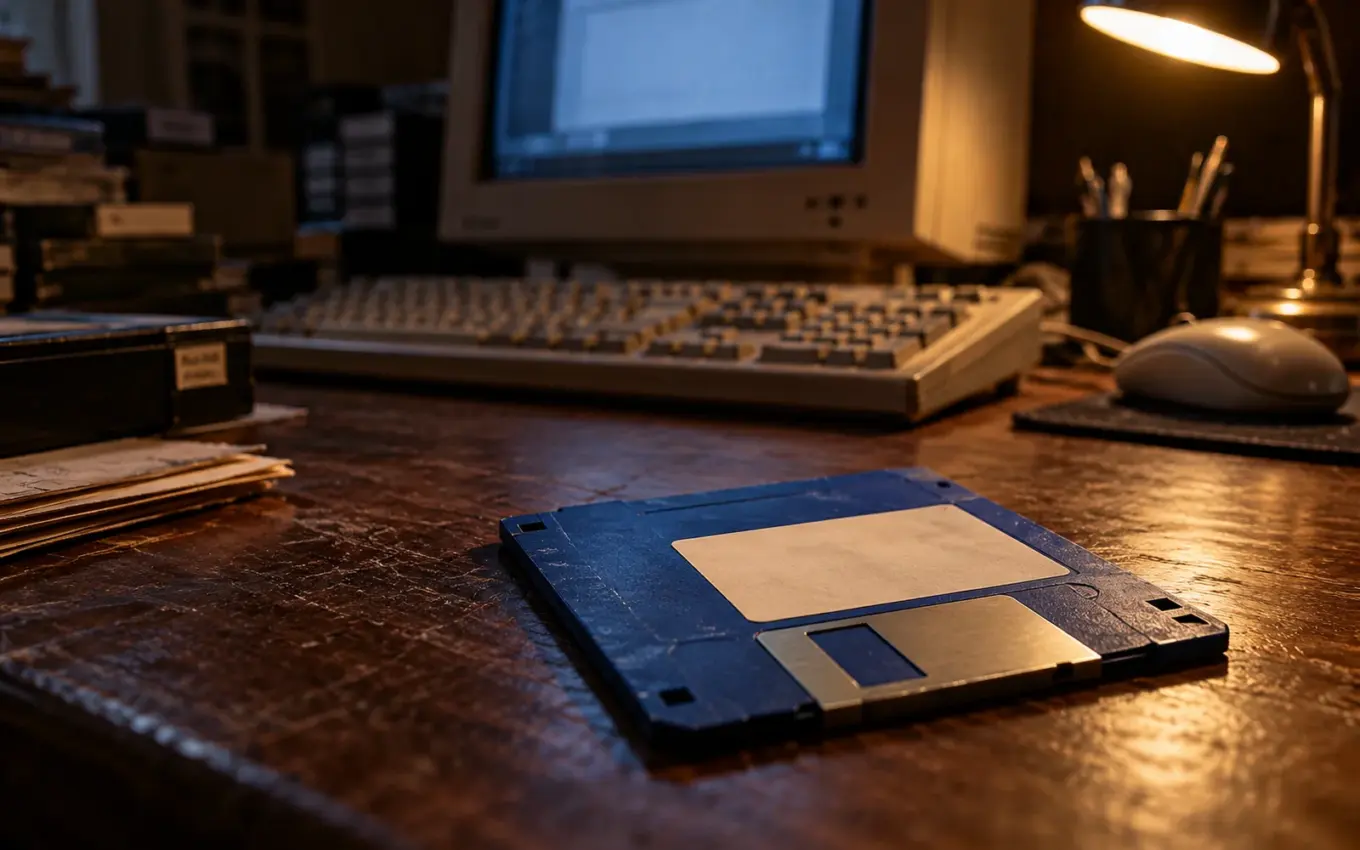
A disk sent during the renewed correspondence was examined by specialists. Information associated with a deleted document pointed towards the name Dennis and a Wichita church. The FBI’s account of its regional computer-forensics laboratories describes the examination as a contribution to identifying Rader.
The clue was powerful because it narrowed a problem that had resisted decades of work. It was not, by itself, proof of ten murders. A digital association with a name and an organisation still had to be connected to a person and checked against other evidence.
That is what makes the detail more compelling than a story about one brilliant trick. The disk belonged within a continuing investigation. Its value depended on forensic examination, earlier communications, knowledge of the local setting and further work that could establish whether the apparent connection was real.
The medium also altered the sender’s relationship with the evidence. A written message could contain a deliberate falsehood; a computer file could carry information about its history that the sender had not intended as part of the message at all. Investigators were no longer limited to the words he chose to place before them. The object carrying those words had become a witness of a different kind.
The name behind the initials
Rader was arrested in 2005 and admitted the killings. He received multiple life sentences. The FBI’s Kansas City office history describes the cooperation that helped unmask him and the further evidence recovered during the investigation.
The public revelation was disturbing partly because it replaced an abstract threat with a person who had maintained an ordinary outward life. The case did not end with the discovery of a stranger who had existed only at the edges of the city. The unknown offender had been part of the same wider community trying to understand the crimes.
His admissions also altered the form of uncertainty for the victims’ relatives. The question of responsibility could be answered. The years in which that answer had been absent could not be removed. A conviction resolves a legal issue; it does not return the time families spent without knowing what had happened or whether the offender might act again.
A quiet interval did not make him disappear
One reason the case remains significant is that it challenges the easy assumption that a serial murderer must continue killing at a steady pace. The established sequence included a long period between the last confirmed murder and Rader’s arrest. The interval did not mean he had ceased to exist.
It also shows the limits of an offender’s control over information. Rader chose the disk as a means of communicating, but could not dictate everything it would reveal. What he intended as another intervention in the investigation became something the investigation could use against him.
The story ends with a name, not a supernatural transformation. The person responsible had always been human, and the traces that helped expose him were human traces too: a first name, an institutional connection and a record left behind by a machine. The fear had lasted for decades. The clue that helped break it could fit in a hand.