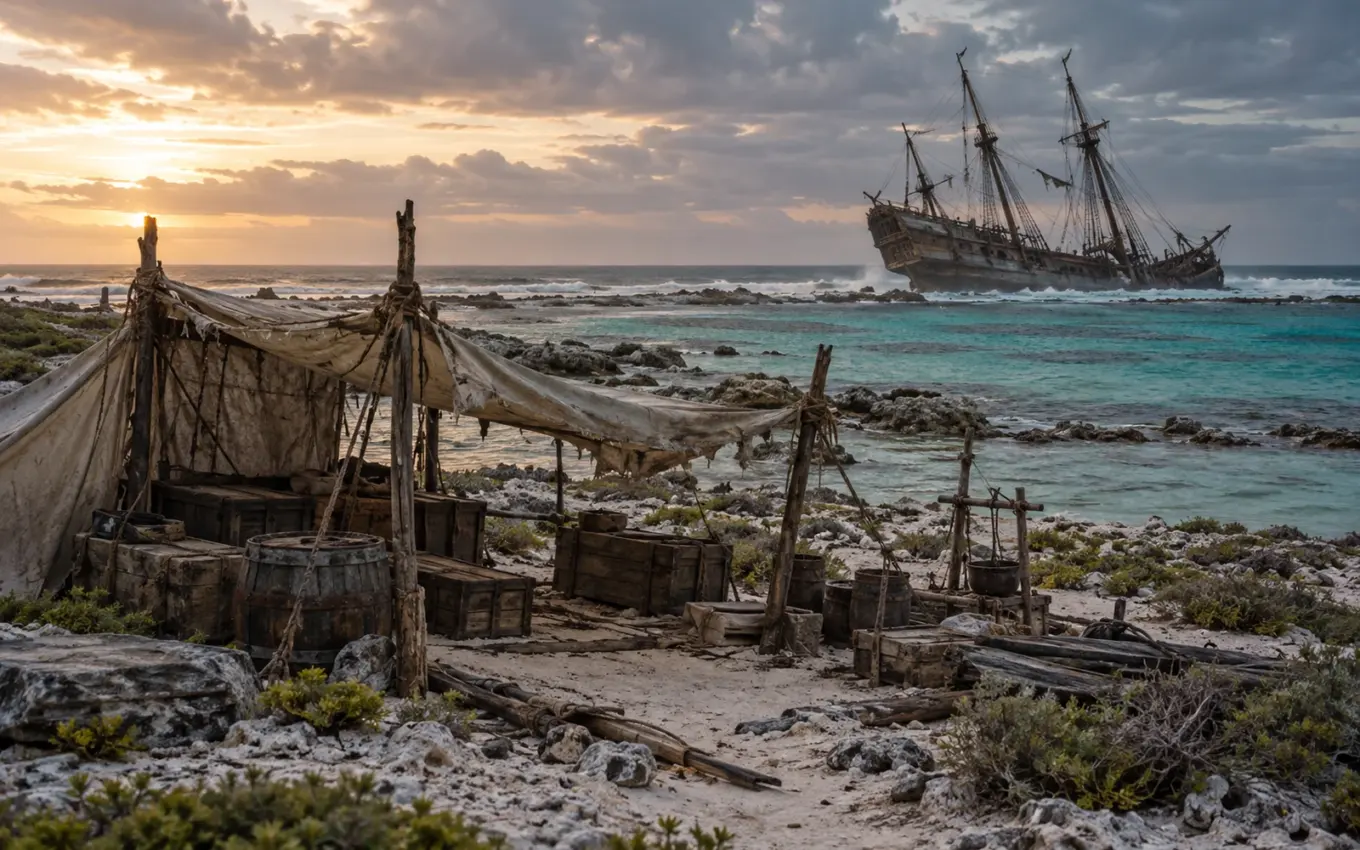
The Batavia shipwreck should have been the worst event its survivors would ever face. In June 1629, a Dutch merchant ship struck a reef off the coast of what is now Western Australia. People who escaped the breaking vessel reached small islands and waited for rescue.
Then men among the survivors began deciding who would be allowed to live.
More than a hundred people were murdered in the aftermath. The danger that had begun at sea took a human form on land. [1]
After the Batavia Shipwreck
Batavia was on her maiden voyage for the Dutch East India Company. The ship carried valuable cargo and a large company of sailors, soldiers and passengers. She struck Morning Reef in the Houtman Abrolhos on June 4.
The survivors did not arrive in a place equipped to support them. They were scattered among islands, with urgent questions about fresh water, food and how anyone would learn what had happened. Commander Francisco Pelsaert left in a boat to seek help. [3]
For those who remained, reaching land was only the first part of survival. A shore could provide a place to stand without providing the means to live. The group needed organisation, supplies and decisions about where people should go.
That need created an opening for someone who could present control as assistance.
A Leader Who Removed the Alternatives
Jeronimus Cornelisz, an officer associated with a mutiny plot before the wreck, assumed power among the stranded people. He and his followers controlled weapons, supplies and movement. Groups were separated, including soldiers sent to another island to look for water.
The separation gave the men in control fewer immediate rivals. It also made it harder for the survivors to understand what was happening elsewhere. The structure of an emergency camp became a structure of coercion. [1]
The murders did not occur as one spontaneous outburst in the confusion of the wreck. They continued over time. The Western Australian Museum’s history places the beginning of the killings in early July and documents the lethal regime that followed. Women, men and children were among the victims. Sexual violence and forced obedience were also part of the terror. [2]
A person trapped on a small island cannot respond to danger in the same way as someone who can walk into the next town. The men controlling the boats and supplies also controlled access to possible escape.
The sea was still there, but now it helped keep people close to their attackers.
The People Sent Away
The soldiers led by Wiebbe Hayes had been sent to West Wallabi Island. Contrary to what Cornelisz may have expected, they found resources that helped them survive. Other survivors reached them and brought news of the murders.
Hayes’s group organised resistance. They built defensive works and resisted attacks from the mutineers. The physical remains of those structures are part of the heritage of the site. [4]
That resistance is crucial to the story. Without it, the aftermath can sound like a sealed world in which one man’s cruelty simply expanded until rescue happened. The people opposing him acted under the same severe limits of isolation. They used the information and resources they had to create a place that could resist his control.
Their survival also threatened the mutineers’ plans for the future. A returning ship could mean rescue for the victims and arrest for the men responsible. Whoever reached it first might determine what the rescuers believed they were approaching.
The islands had become more than a set of camps. They held competing accounts of the disaster, one of which needed witnesses silenced.
A Race Toward Rescue
Pelsaert returned in the rescue vessel Sardam in September. Hayes’s men reached him with warning of the murders and the threat posed by the mutineers. Cornelisz’s control was broken, and the surviving people could finally leave the islands. [4]
Rescue did not erase what had happened. It established that there would be people able to report it. The history survives through testimony, records and archaeological investigation rather than through a legend detached from evidence.
The exact totals differ across historical accounts, but the scale is beyond dispute: the survivors of a shipwreck were subjected to organised killing by people who should have been sharing the work of staying alive. [2][3]
The Batavia shipwreck is frightening because it overturns the order in which danger is supposed to end. The ship strikes the reef; people struggle through the water; land appears. A conventional survival story would make that arrival the beginning of relief.
Here, relief depended on the conduct of the people who had also survived.
The islands did not change from safe to dangerous because something unknown came out of the darkness. The danger was already among the company. Isolation allowed it to acquire weapons, boats and the language of authority.
Some people resisted. Some escaped long enough to warn others. Many never had the opportunity.
They had survived the sea, only to discover that reaching land had placed them within somebody else’s power.
Sources and record notes
Record type: Researched nonfiction. Filed: October 15, 2026.
Established facts: Batavia struck Morning Reef on 4 June 1629. During the commander’s absence, Jeronimus Cornelisz and followers murdered more than 100 survivors. Wiebbe Hayes’s group resisted and helped warn the rescue ship.
Uncertainty: Passenger and survivor totals differ between historical accounts. The article avoids presenting disputed totals or modern psychological diagnoses as settled facts.
- National Museum of Australia — Wreck of the Batavia
- Western Australian Museum — Batavia’s history, 1628–1963
- Australian National Maritime Museum — The Batavia shipwreck disaster
- Australian Government — Batavia Shipwreck Site and Survivor Camps Area
Explore the DarkRecord story archive, or read how DarkRecord labels and sources its stories.