Fiction notice: This original horror story is presented in first person. Names, places and events are fictional, and the account is not independently verified because it is not presented as fact.
Please do not use my name.
I have changed the name of the street, the company where I worked, and a few details about the city. I am not doing that to make the story more dramatic. I am doing it because I still do not know who he was, and I am afraid he may recognize the details if this is published.
This happened three years ago, when I was thirty-two and living alone in a small apartment in western Sweden. Until then, I had never thought of myself as an anxious person. I walked home after dark. I wore headphones on public transport. I sometimes forgot to lock my balcony door.
I do none of those things now.
The first time I noticed him
I first saw the man on a Tuesday evening in November. I remember the day because Tuesdays were when I stayed late at work to finish the weekly accounts.
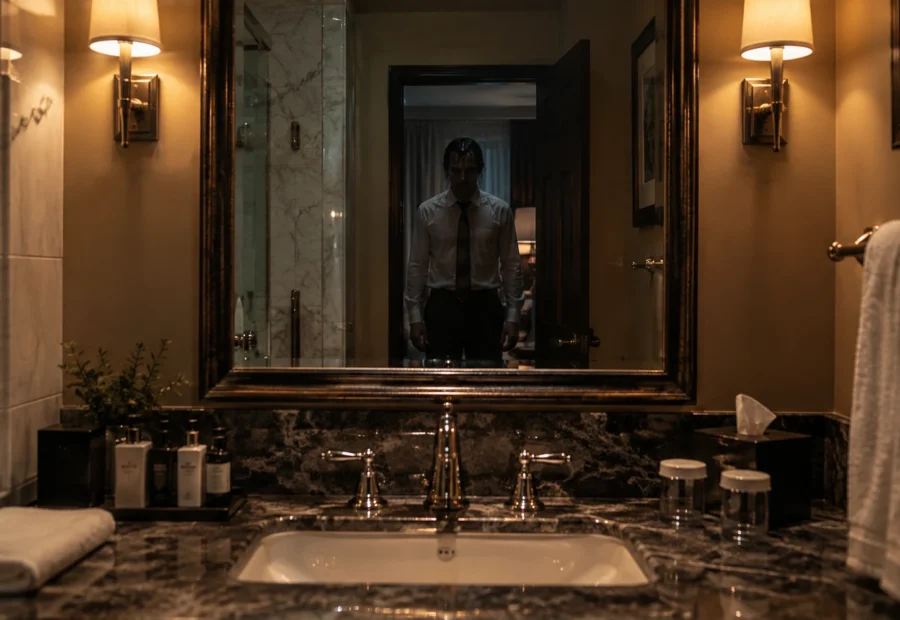
It was raining, and the tram windows were fogged from everyone’s wet coats. I was standing near the back doors when I noticed a man in the reflection.
He was perhaps forty, though it was difficult to tell. He wore a grey cap pulled low, a dark work jacket, and clean white trainers that looked wrong for the weather. He was not staring at me directly. He was looking at my reflection in the glass.
When I turned around, he looked down at his phone.
I got off at my usual stop. So did he.
That did not frighten me. Hundreds of people used that stop. I walked toward the supermarket, and he continued straight ahead. By the time I came out with my groceries, I had forgotten about him.
Then I saw him again two evenings later.
Same grey cap. Same dark jacket. Same white trainers.
He was standing across the street from my building, pretending to read the timetable at a bus stop for a bus that had already stopped running for the night.
I did not go home. I kept walking and called a friend. I spoke loudly, saying I was almost there, as if someone were waiting for me nearby.
When I looked back, the bus stop was empty.
He learned my routine
For the next week, nothing happened.
I told myself I had seen two different men wearing similar clothes. I felt embarrassed that I had been frightened. There is a special kind of shame in suspecting a stranger who has technically done nothing.
Then I started seeing him everywhere.
At the bakery near my office, standing outside without buying anything.
At the tram stop two stations before mine.
In the reflection of a pharmacy window while I waited at a crossing.
He never approached me. He never smiled. He never held my gaze long enough for me to confront him.
That made it worse.
If he had spoken to me, I could have told him to leave me alone. If he had threatened me, I could have shown the threat to the police. Instead, he remained just far enough away to make every sighting seem explainable.
I changed my journey home. I took a bus in the opposite direction, walked through a shopping centre, and doubled back on another tram.
He was waiting near my building when I arrived.
He was not at the bus stop this time. He was standing beneath the awning of the closed hair salon opposite my entrance.
I stopped at the corner.
He lifted his head.
Even from that distance, I knew he had seen me.
Then he tapped the side of his cap with two fingers, almost like a greeting, and walked away.
The message through the intercom
I called the police for the first time that night.
The officer was kind, but there was little they could do. The man had not followed me into the building, touched me, spoken to me, or made a direct threat. I was told to write down dates and times, photograph him if I could do so safely, and call immediately if he tried to enter the building.
I started keeping a log.
November 19, 18:42 — outside the bakery.
November 21, 21:10 — opposite my apartment.
November 24, 07:35 — on the platform when I left for work.
The list made me feel less irrational. It also showed me something I had not wanted to admit.
He knew when I left home.
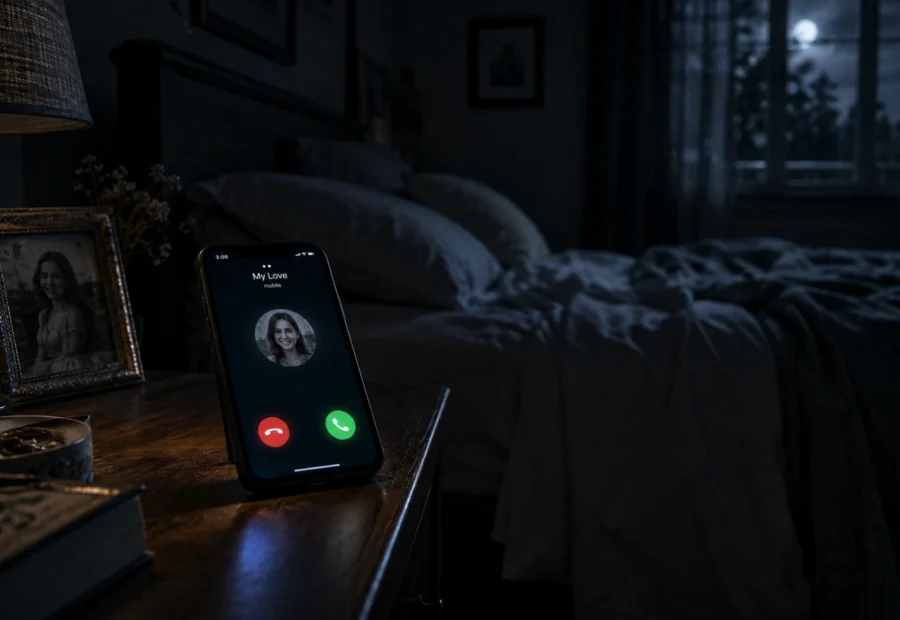
On the last Friday of November, my intercom rang at 2:13 in the morning.
The sound pulled me out of sleep so suddenly that I sat upright without understanding where I was. The intercom rang again.
I did not answer.
After the third ring, I crept into the hallway and lifted the receiver without speaking.
At first, I heard only static and traffic in the distance.
Then a man whispered, “Your kitchen light is still on.”
I dropped the receiver.
My kitchen light was on.
From the kitchen window, I could see the pavement and part of the courtyard, but not the front entrance. I turned off the light and stood behind the curtain, trying to look through a gap without moving the fabric.
No one was there.
The police arrived twenty minutes later. They checked the entrance, the courtyard, the basement, and the street. The officer asked whether anyone I knew might be trying to frighten me. An ex-partner. A colleague. A neighbour.
I gave them every name I could think of.
None of them matched the man in the grey cap.
Someone had been inside
My landlord changed the lock on my apartment door. I bought a small camera for the hallway and another for the living room. I stopped posting online. I asked my manager not to tell anyone my schedule.
For almost two weeks, the man disappeared.
I began to believe the police visit had frightened him away.
Then small things started moving inside my apartment.
The bathroom cabinet was open when I was certain I had closed it.
A mug I always kept beside the kettle was on the dining table.
My bedroom window was unlocked.
Nothing was stolen. There were no marks around the door. The cameras showed only me coming and going.
I blamed stress. I was sleeping badly and checking everything repeatedly. I knew that people under pressure could misremember ordinary actions. I even started taking photographs before leaving for work: the locked window, the closed cabinet, the mug beside the kettle.
One evening, I came home and found a supermarket receipt on the floor of my hallway.
It was from a shop I never used, time-stamped earlier that afternoon while I had been at work.
Only one item had been purchased.
A packet of mint chewing gum.
I could smell mint in my bedroom.
I left without checking the rooms. I ran down the stairs and waited outside in the rain until the police arrived.
They searched the apartment. No one was inside. There were no usable fingerprints on the receipt. The building’s main entrance had an old lock, and residents often let strangers in without asking who they were visiting.
The officers suggested that I stay elsewhere.
I moved in with my older sister the next morning.
The photograph
My sister lived twenty minutes away. I told almost no one where I was staying.
For the first few nights, I slept on her sofa with the television on. Every sound from the stairwell made my body go rigid. My sister tried to reassure me, but I could see that she was frightened too.
On the fifth morning, an envelope was pushed through her letterbox.
There was no stamp, no address, and no writing on the outside.
Inside was a photograph of me asleep on my own bed.
I was lying on my side, facing the wall. The photograph had been taken from the foot of the bed. My bedroom door was visible on the right side of the image.
It was open.
I stared at the picture for a long time before I noticed the date printed in tiny numbers at the bottom.
It had been taken six days earlier.
The night before I moved out.
I had slept in the apartment that night because the police had already searched it. I remember checking the new lock twice. I remember placing a chair beneath the handle even though I knew it would not stop the door from opening inward.
I did not hear anyone enter.
The police took the photograph and the envelope. My sister’s building had a camera over the main entrance, but its recording system had been broken for months. A neighbour remembered seeing a delivery driver in a dark jacket that morning. She could not describe his face.
When I returned to my apartment with two officers, they inspected the bedroom again. One of them found a faint scrape around the metal plate of the lock, but the locksmith could not say whether it was new.
The hallway camera had recorded nothing unusual.
Later, while reviewing the footage, I noticed something that still makes me feel sick.
At 03:17 on the night the photograph was taken, the camera image froze for eleven minutes.
It did not go black. It showed an empty hallway, perfectly still.
At 03:28, the image jumped. The shadow beneath my front door changed, as though someone on the inside had stepped away from it.
I tried to disappear
I resigned from my job. I changed my telephone number. I deleted my social accounts and moved to another part of the country.
The police investigation remained open for a while, but there was no identified suspect. The man had never shown his full face to a camera. No one could connect him to my building. The photograph contained no fingerprints or useful digital information.
People sometimes ask whether I had an ex who might have done it.
I did not.
They ask whether I was involved in a dispute at work.
I was not.
They ask whether I may have imagined seeing the same man in different places.
I wish I had.
For nearly a year after moving, nothing happened. I rented a small flat under a slightly altered version of my name. I told only my parents, my sister, and the police where I lived.
I began sleeping again. I stopped checking beneath my car. I could stand at a tram stop without studying every reflection.
Then, one Monday in February, I received a postcard.
It showed a photograph of the harbour in my new city. There was no message on the front.
On the back, in neat block letters, someone had written:
YOU STILL CHECK THE LOCK TWICE.
The postcard had been posted locally.
The last time I saw him
I moved again.
I will not say where I live now. I do not use my real surname online. I do not give delivery companies access to my entrance. I have cameras inside and outside my home, and I test them every week.
There has been no postcard for more than a year.
But last autumn, I saw a man on a train.
He was sitting three rows ahead of me, wearing a grey cap. I could not see his face. I told myself it was a common cap, a common jacket, a common shape of man.
Then the train entered a tunnel, and the window became a mirror.
He was looking directly at my reflection.
I stood up so quickly that my bag fell into the aisle. Other passengers turned to look. The man did not move.
At the next station, I stepped onto the platform and waited for the doors to close.
He remained in his seat.
As the train began to move, he raised two fingers and tapped the side of his cap.
The same small greeting he had given me outside my old apartment.
I called the police again. They checked the station cameras, but the angle did not show his face clearly. They could not confirm that he was the same person.
I know what I saw.
I also know how this sounds. That is why I have waited so long to tell anyone beyond my family and the police. When you describe stalking, people expect a reason. They want an ex-partner, a rejected date, a message, or a confrontation. They want the danger to have a beginning they can understand.
Mine did not.
A stranger noticed me on an ordinary Tuesday evening and learned when I worked, where I lived, which light I left on, and how I slept.
I still do not know his name.
I do not know how he entered my home.
I do not know whether he has stopped.
Every night, I lock the door twice.
And every morning, before I open it, I check whether an envelope has been pushed underneath.