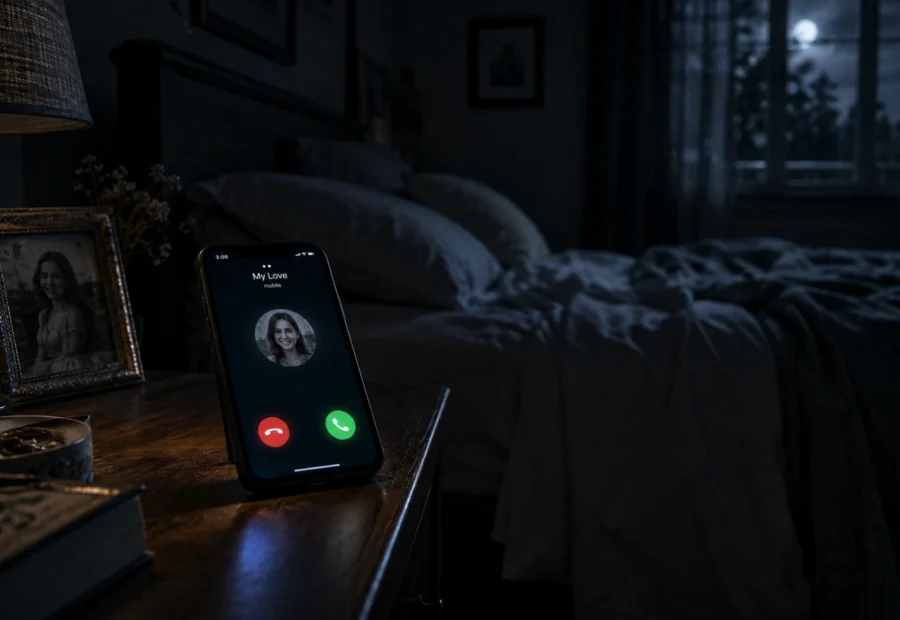
Content warning: This phone horror story contains stalking, surveillance, threatening messages, home-invasion themes and intense psychological distress.
Fiction notice: This original horror story is presented in the first person. Names, places and events are fictional, and the account has not been independently verified because it is not presented as fact.
This phone horror story began four years ago, when I was thirty-six and working nights at a distribution warehouse outside a medium-sized Swedish city.
You can call me Jon Doe.
That is not my real name. I use it because the person in this story may still know where I live and because I have a wife now. She knows what happened, but she does not know every detail. Whenever I try to describe the worst part, I feel that saying it aloud might make everything start again.
Back then, I lived alone in a rented house at the edge of a small village. The rent was low because the property stood beside an abandoned sawmill, almost half a kilometre from the nearest neighbour.
At first, I considered the isolation a benefit.
Now I cannot understand why I ever wanted to live somewhere no one could hear me shout.
The first message in this phone horror story
My shifts ended at 2:00 in the morning. Usually, I arrived home around 2:35, ate something, watched television for an hour and went to bed after four.
One Tuesday in October, I parked beside the house and noticed the kitchen light burning.
I was certain I had switched it off.
For a moment, I stayed in the car and watched the window. Nothing moved behind the curtains.
The front door remained locked. In addition, I found no marks around the frame, no broken windows and nothing missing inside. After checking every room, including the loft, I found no one.
Night work made the days blur together, so I blamed myself. I had also been sleeping badly.
At 3:12, while I made coffee, my phone vibrated.
A voice message had arrived from my own number.
At first, I assumed a network error had caused it. The recording lasted seven seconds.
For five seconds, a low rushing sound filled the audio.
Then my own voice whispered, “Do not look through the kitchen window.”
Every muscle in my body tightened.
The phone almost slipped from my hand.
Although the voice sounded like mine, something was wrong with it. The words came out flatter and slower, close to the microphone, as if the speaker feared someone in another room might hear.
I obeyed the warning and kept my eyes away from the window.
Instead, I closed the kitchen door, turned off the light and called my mobile provider. An automated service told me the offices had closed for the night.
Before dawn, I locked the bedroom door and placed a hammer beside the bed.
Someone had been near the house
In daylight, the message felt less frightening. After listening several times, I almost convinced myself that I had accidentally sent an old recording.
However, the message information showed a timestamp of 3:11 that morning.
My call history contained no outgoing message.
Later, the provider explained that someone could falsify caller information. Because the displayed number matched mine, blocking it would also block my own voicemail and related services.
Before work that evening, I walked around the house.
Muddy marks lay beneath the kitchen window.
They were not shoe prints.
Instead, two long impressions sat side by side in the wet soil, as though someone had knelt there for a long time.
I photographed the marks and called the police. An officer examined the property but found nothing that clearly proved a crime.
Perhaps, he suggested, a hunter or a teenager had been fooling around.
At first, I left out the voice message. When I finally played it, he listened twice and asked whether I had recorded it as a joke.
I told him I had not.
He wrote down the details. Even so, his expression made it clear that he did not know what to do with them.
The phone horror story knew my routine
For nine days, nothing happened.
Then another voice message arrived while I drove home.
Again, the screen displayed my number.
This recording lasted twelve seconds.
First came the sound of my car engine, the indicator clicking and my own breathing.
Next, a voice said, “Take the next road.”
I was approaching the turn towards my house.
Rather than taking it, I continued to a petrol station twenty kilometres away and remained beneath the bright lights until sunrise.
The sounds from inside my car frightened me more than the warning. It did not resemble a live call from someone following behind. Instead, it sounded as though a microphone sat near the passenger seat.
The next day, I searched the vehicle. I removed the mats, checked beneath the seats, emptied the boot and opened every plastic panel I could reach.
Nothing was there.
Over the following month, the phone horror story continued through irregular messages.
Some contained only background noise: a door closing, water running or my footsteps on gravel.
Others delivered brief warnings.
“Leave the bathroom light on.”
“Do not sleep in the bedroom.”
“He is in the shed.”
Eventually, I stopped opening them alone.
A colleague named Martin lived nearby and knew what was happening, so I forwarded every recording to him. He believed someone at work was tormenting me. Therefore, we changed my shift, hid the new schedule and parked my car behind the warehouse, beyond sight of the road.
Nevertheless, another message arrived ten minutes before the unfamiliar shift ended.
My own voice said, “Martin should not drive behind you tonight.”
No one knew that Martin planned to follow me home.
The light inside the abandoned sawmill
Martin followed me despite the warning.
As we entered the village, a light moved inside the abandoned sawmill.
The owners had left the building unused for more than a decade. Broken windows lined its walls, while a chain-link fence blocked the entrance.
Beyond the fence, the light resembled a torch passing between the machines.
We parked on the road and called the police. While we waited, the light vanished.
Then my phone vibrated.
The new message lasted only three seconds.
Someone whispered, “He can see Martin.”
At that exact moment, something smashed through the rear window of Martin’s car.
Both of us ducked.
A stone rested on the back seat among the broken glass. Black thread held one of my work gloves around it.
I had lost that glove two weeks earlier.
Police officers searched the sawmill with dogs but found no one. Inside one office, however, they discovered food wrappers, cigarette ends, blankets and a plastic chair facing a window that overlooked my house.
They also recovered a notebook.
Someone had torn out most of the pages.
Only one page remained, covered with times.
2:34.
2:41.
3:08.
4:12.
The entries matched the times when I usually arrived home, showered, switched off the kitchen light and went to bed.
After that discovery, the police treated the case as stalking.
The microphones changed the case
I stayed with Martin while officers inspected my house and car.
A technician found a small microphone concealed inside the car’s interior light. It contained a battery, a memory card and a wireless transmitter.
Another device sat beneath the kitchen table.
Neither carried usable fingerprints.
Investigators believed someone had entered the house with a copied key or slipped inside while I worked. The lock showed no damage.
According to my landlord, only three keys existed: mine, his and a spare kept in his office.
The spare had disappeared, although no one had forced the office door.
Over the next several weeks, detectives questioned me about colleagues, former partners, neighbours and anyone I might have offended. I gave them every name I could remember.
Still, they identified no suspect.
Once the technicians removed the microphones, the messages stopped.
Before the month ended, I left the house.
For a while, I believed the phone horror story had ended.
The recording from my bedroom
Three months later, the detective handling the case asked me to visit the station.
A technical team had recovered deleted audio from the memory card inside the kitchen device.
Most files contained ordinary sounds: cooking, telephone conversations and television programmes.
One file, however, captured the house at 4:18 on the night of the first message.
Although the microphone sat in the kitchen, it could pick up sounds from my bedroom through the hallway.
For several minutes, the refrigerator hummed alone.
Then the back door opened.
Footsteps crossed the kitchen.
A chair scraped against the floor.
For almost twenty minutes, someone remained there without speaking.
At 4:39, the footsteps moved towards my bedroom.
My snoring carried through the hallway.
The intruder stopped outside my door.
Suddenly, my own voice whispered from a position very close to the kitchen microphone:
“Not tonight.”
The detective paused the recording.
He asked whether I remembered leaving the bed.
I did not.
When he resumed the file, footsteps returned to the kitchen. The back door opened and closed.
At 4:43, the recording captured me waking, walking into the kitchen, drinking water and returning to bed.
None of it existed in my memory.
Police analysts compared the whisper with samples of my speech. The voices sounded similar, but the analysts could not confirm a match.
I asked whether two people had entered the house.
The detective said the audio could not prove it.
Then I asked whether someone might have played a recording of my voice through a speaker.
He agreed that it was possible.
“Why would anyone do that?” I asked.
He had no answer.
The man at the warehouse
The investigation remained open for almost a year.
Then police arrested a security guard from my old workplace for stealing fuel and equipment. During a search of his home, they found copied keys, photographs of employees and several cheap recording devices.
He knew my old schedule.
In addition, he could enter the staff changing room where I kept my coat and keys.
He had also worked briefly for my landlord’s maintenance company.
For the first time, I felt certain the police had found the man.
However, the evidence did not fit.
Hospital records showed that he had received treatment on the night the stone shattered Martin’s window.
His phone records also placed him in another city when several messages arrived.
He denied knowing me outside work.
Police charged him with unrelated thefts, not with stalking me.
When I asked whether he might have had an accomplice, the detective said they had considered that possibility.
He refused to say more.
The final phone horror story message
I changed my phone number twice.
After moving to another city, I found a daytime job. More than two quiet years passed.
During that time, I met the woman who is now my wife. We bought a small townhouse in a neighbourhood filled with families, streetlights and houses close enough that people notice unfamiliar cars.
Gradually, I began to feel normal again.
Then, last December, my wife and I returned from dinner and found the porch light off.
It operated automatically and had never failed before.
As I unlocked the door, my phone vibrated.
The screen displayed my own number.
Almost three years had passed since the previous message.
This time, I refused to play it.
Instead, I called the police and waited in the car with my wife. Officers searched the house and garden, but no one appeared to be there. Nothing had vanished.
For two weeks, the message remained unopened.
Eventually, I listened to it at the police station.
The recording contained the sounds of my wife and me eating dinner at the restaurant that evening.
Glasses touched the table. My wife laughed. Then I heard myself suggest leaving before the snow became heavier.
A man’s voice spoke from very close to the microphone.
It did not sound like mine.
“Jon still thinks there was only one of us,” he said.
No one had ever called me Jon—not my family, my colleagues or the police.
Jon was the false name I had typed at the top of a draft of this story.
The file existed only on my computer at home.
I had never sent it to anyone.
Why I am sharing this phone horror story
Police technicians examined my computer but found no clear evidence of remote access. They also found no signs of forced entry, while the alarm log showed nothing unusual.
The case remains unresolved.
I am sharing this phone horror story because keeping it private has not protected me.
Perhaps the person wants me to stay silent. Alternatively, he may enjoy knowing that I cannot explain how he reaches me.
Occasionally, calls still arrive from my own number.
I never answer them.
Last week, one came at 3:11 in the morning.
That was the exact time of the first message.
After one ring, the call stopped.
When I checked the hallway camera, the porch looked empty.
However, the camera’s microphone had captured someone standing just outside its field of view.
For eleven minutes, the recording contained only breathing.
Then my own voice whispered from the other side of the front door:
“Do not wake your wife.”
Real-world phone spoofing and stalking resources
This story is entirely fictional. In real life, caller ID can display a false name or number, including a number that looks familiar. Read the Federal Trade Commission’s guidance on phone scams and caller-ID spoofing. Anyone experiencing repeated surveillance, threatening contact or stalking can also review SPARC’s stalking safety information and the Swedish Police guidance for reporting a crime.